
SEO for professional services makes a consulting, accounting, legal, engineering or IT services firm easy to find and easy to vet when a buyer searches. It works best when most of your growth comes from a small number of high-value engagements and buyers check you online before they reply. It works poorly when every client arrives by personal introduction and nobody ever searches for you.
- Buyers of expert services often hear about a firm from a referral, then search to check it. Your site has to hold up under that check.
- Pages that earn inquiries: one page per service, pages for the industries you serve, and a profile page for each partner or senior practitioner.
- Firms with confidentiality limits can still show proof: scoped, anonymized work, public credentials, and named authors.
- Measure inquiry quality, not traffic. A handful of right-fit inquiries beats hundreds of visits.
- Published timelines range from three to twelve months. No source measures it for your firm, so plan around factors, not a promise.
What SEO for professional services means
Professional services firms sell expertise. The product is judgment, so trust does most of the selling. SEO for these firms therefore has two jobs. It puts you in front of buyers who search for the problem you solve, and it gives those buyers evidence that your people can be trusted with it.
That differs from SEO for a product catalog or a software free trial. Nobody adds a tax advisor to a cart. The visit ends in an inquiry, a call, or a quiet decision to shortlist you, and the sale takes weeks or months. This guide covers the segment. If you are comparing what a B2B SEO provider does in general, see our B2B SEO agency page and the B2B SEO services guide.
The firms it fits: consultancies, accounting and advisory firms, law firms serving businesses, engineering and architecture practices, and IT services providers. The firms it fits poorly: very small practices with a full book of referrals and no wish to grow, and firms where a single partner relationship decides every deal.
How buyers find and vet a professional services firm
Most buyers of expert services use search in two different ways, and a firm needs to cover both.
Discovery searches describe a problem or a service: a buyer looks for a transfer pricing advisor, a SOC 2 readiness consultant or an employment law firm for a growing company. You win these with service and industry pages and with content that answers the questions buyers ask before they hire.
Verification searches follow a referral, a conference conversation or a LinkedIn message. The buyer types your firm name, or a partner's name, and reads what comes up. This is the step competitors' guides tend to skip. It means your own name, your people and your proof matter as much as any service keyword.
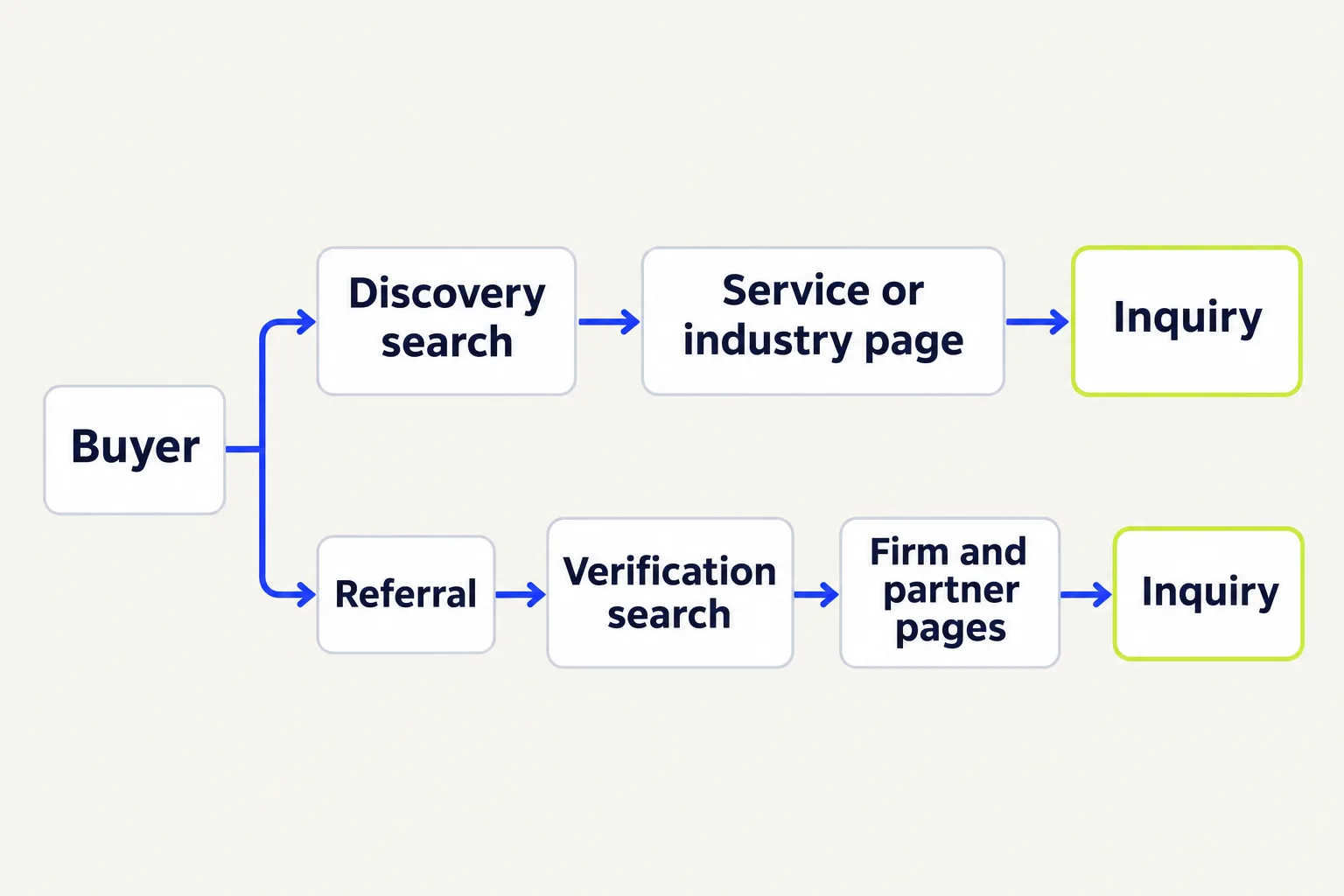
A practical test: search your firm name and each partner's name in a private window. If the first page shows a thin team page, an out-of-date directory listing or nothing about what you actually do, referrals are leaking before they reach you.
Pages that earn inquiries
A professional services site often has one "Services" page with a list of bullets. Search engines and buyers both need more. Each distinct service and each important industry deserves a page that can answer a real search on its own.
| Page type | What the buyer is asking | What it should contain |
|---|---|---|
| Service page | "Can this firm do this exact work for a company like mine?" | Who it is for, the problem, the scope, how an engagement runs, who leads it, how to start |
| Industry page | "Do they understand my sector's rules and pressures?" | Sector-specific problems, regulations or standards you work under, relevant services, named experts |
| Partner or practitioner profile | "Who would I be working with, and are they qualified?" | Role, credentials, areas of focus, publications and talks, a direct way to reach them |
| Proof page or section | "Has this firm solved something like this?" | Scoped examples, anonymized if needed; method; what changed; honest limits |
| Question-led article | "What does this cost, how long does it take, what are the risks?" | A direct answer in the first sentence, then the detail, written or reviewed by a named expert |
Two points deserve emphasis. First, do not build a page for every combination of service, industry and city. Build a page when you have something true and useful to say and a real service behind it. Thin variations of one template add pages without adding answers. Second, link these pages to each other: service to industry, industry to the people who lead the work, people to the articles they wrote. That gives buyers a path and gives search engines a clear picture of what the firm is.
Credibility when you cannot name clients
Every guide on this topic says to publish case studies. Many professional services firms cannot. Client confidentiality, professional rules and non-disclosure terms often rule out names, numbers and sometimes the matter itself. You still have options that are honest and useful to a buyer:
- Anonymized engagement summaries. Describe the situation, the approach and the outcome in general terms, with the client's permission and your compliance team's sign-off.
- Method pages. Show how you scope, staff and run a type of engagement. A clear method is evidence of experience.
- Verifiable credentials. Licenses, certifications, bar or society memberships, and published work that a buyer can check elsewhere.
- Named authorship. Put a real person's name and profile on expert content, and keep the profile current.
- Third-party mentions. Talks, panel appearances, bylines in trade publications and listings in industry bodies you actually belong to.
What to avoid: invented results, vague superlatives, and testimonials you cannot back up. A buyer who is trusting you with a sensitive problem notices.
Local, regional or national: pick the scope first
Whether local SEO matters depends on how clients buy. If clients visit your office or expect a nearby firm, a complete Google Business Profile for each office, consistent name, address and phone details, and reviews from real clients are part of the foundation. Law and accounting practices serving local businesses usually fall here.
If you sell to companies across the country and work remotely, location pages add little. Spend the effort on service pages, industry pages and your people. Multi-office firms usually need both: a page and a profile per office, plus national service and industry content that does not depend on a city.
Decide this before you plan content. The scope shapes keywords, page types and how you measure success.
Content that fits expert work
Professional services content should answer the questions a client would otherwise ask on the first call. Good prompts: what the engagement costs and what drives the cost, what you need from the client, what typically goes wrong, what the alternatives are, and when you would tell a prospect they do not need you.
Use real expertise. A page that restates what any competitor says adds nothing, and AI answers already summarize generic advice. The material that tends to hold up is specific: a worked example, a checklist from your own practice, a regulation explained in plain terms with a date and a source. Put the answer in the first sentence under the heading, then give the detail.
Keep the scope of each page narrow. One page should answer one question or serve one service. That is also how a reader who lands mid-page understands it without the rest of the site.
How it differs by firm type
The same principles apply across firm types, but the searches and the proof differ.
| Firm type | Typical buyer searches | Proof that fits |
|---|---|---|
| Consulting | A business problem or method, such as pricing strategy or operations review | Method pages, frameworks written by named consultants, scoped examples |
| Accounting and advisory | A compliance or tax question, often with a location or an industry | Credentials, plain-language explainers with dates, industry pages |
| Legal | A matter type for a business, often with a jurisdiction | Attorney profiles, bar admissions, practice-area pages, careful anonymized summaries |
| Engineering and architecture | A project type, standard or sector | Project descriptions the client allows, certifications, team profiles |
| IT services | A managed service, platform or compliance need | Service scope, certifications, security practices, integration details |
Regulated fields, such as law and accounting, add rules about what you may claim in marketing. Check your professional body's advertising rules before you publish outcomes or comparisons.
Common mistakes
- One "Services" page for everything. It cannot rank for specific work or answer a specific buyer.
- Team pages with a photo and a title only. Buyers search people. Give them something to read.
- Content written by marketing with no expert input. It reads like every other firm's blog.
- Measuring visits. Traffic can rise while inquiries stay flat.
- Waiting for a perfect site. Fix the pages buyers see first, then expand.
Technical basics and AI search
Technical work is usually a short checklist for a firm of this kind: pages that load fast on a phone, a clean crawl with no blocked service pages, one canonical URL for each page, a sensible internal link structure, and a sitemap. Structured data helps describe what a page is. For the firm itself, Google's documentation says Organization structured data helps Google understand details about an organization and tell it apart from other organizations.
AI search is now part of how buyers research providers. Google states that there are no additional requirements to appear in AI Overviews or AI Mode, no special optimizations, and no special schema.org structured data needed. In practice that points back to the same work: indexed, clear, accurate pages that state who you are, what you do and who leads it, with consistent facts about the firm across the web. We cover this in more depth in our guide to AI search for B2B.
Measure inquiry quality, not traffic
Organic traffic is the wrong headline number for a firm that wins a few engagements a quarter. A hundred extra visits mean little if none of the visitors can hire you. Track what happens after the form is submitted.
A simple scorecard, which you can build in a spreadsheet or your CRM, gives each inquiry a source and a fit rating. These fields are a suggested method, not an industry standard:
| Field | What to record | Why it matters |
|---|---|---|
| Source | Organic search, referral, direct, social, other; the landing page and the search that led there | Shows which pages bring inquiries, and whether a referral searched you first |
| Fit | Right size, right sector, right service, or not a fit | Separates volume from value |
| Intent | Specific need and timeline, or general curiosity | Predicts whether a call is worth booking |
| Outcome | Qualified, proposal sent, won, lost, no response | Connects SEO to revenue where your data allows |
Also watch the branded side: searches for your firm and partner names, and what Google Search Console says people typed before they reached you. Rising branded searches after a speaking engagement or an article shows the verification path working. Attribution will stay imperfect, because a referral that searched you and then called may show up as direct traffic. Record what you can and say so in the report.
How long SEO for professional services takes
Agency guides give different answers. Some say three to six months for early movement; others say nine to twelve months for results that show up as business. None of the pages we read cites a study behind its number, so treat them as estimates from agencies, not measurements.
Your own timeline depends on factors you can inspect:
- How much of the site already exists and how well it is built.
- How competitive the services are, and how many established firms already rank.
- How quickly your experts can supply material and review pages.
- How long your sales cycle is. An inquiry that arrives in month five may close in month nine.
Plan for a quarter of foundation work before you judge results, and review inquiry quality alongside rankings. Anyone who promises a ranking or a number of leads by a set date is guessing.
How Stijg Media approaches it
Stijg Media is a founder-led B2B SEO and AI search agency. Adriaan van Swieten, who has about eight years of SEO experience, leads the strategy and the implementation, so there are no handoffs between a strategy deck and the people who build the changes. The work starts by mapping the searches and AI prompts your buyers use, then moves to a plan ranked by likely revenue impact, improvements to the site, authority building, and measurement with a monthly update.
Stijg Media has no professional services case studies to show you, and this page does not imply any. We explain the segment and how the work applies to it. Scope is custom, pricing is quoted after a free analysis (see B2B SEO pricing for how costs usually work), and engagements run month to month. We do not guarantee rankings. If you want to see where your firm stands first, a B2B SEO audit is the usual starting point, and our guide on how to choose a B2B SEO agency lists the questions to ask any provider, including us.
Want a view of how buyers find and check your firm? Ask for a free SEO and AI visibility analysis.
Where to start
- Search your firm name and each partner's name, and fix what a buyer would find.
- List your services and decide which ones deserve their own page.
- Write one profile for each senior practitioner, with verifiable credentials.
- Decide whether your scope is local, regional or national.
- Set up the inquiry scorecard before you publish anything, so you have a baseline.
If you want a partner to run this with you, tell us about your firm.
Frequently asked questions
Does SEO work for firms that get most clients by referral?
Yes, because referrals usually search for you before they call. They type your firm name or a partner's name and judge what they read. SEO makes that check go well and adds a second source of inquiries from buyers who have never heard of you. It does less if you never want new clients outside your network.
Do professional services firms need a page for each partner?
A profile for each senior practitioner is worth having, because buyers search people as well as firms. Each profile should state the role, verifiable credentials, areas of focus and published work, and give a way to reach that person. Junior staff do not each need a page; a short team listing is enough.
Can we do SEO if client confidentiality limits our case studies?
Yes. Use anonymized, scoped summaries with client permission and compliance review, method pages that show how you run an engagement, verifiable credentials, named authors, and third-party mentions. Do not invent results or imply clients you cannot name. Buyers handling sensitive matters notice vague or unsupported proof.
Is local SEO important for professional services firms?
It depends on how clients buy. If clients expect a nearby office, a complete Google Business Profile for each office, consistent contact details and genuine reviews matter. If you serve companies nationally and work remotely, location pages add little and effort is better spent on service pages, industry pages and your people.
How long does SEO take for a professional services firm?
Published estimates differ. Agency guides range from three to six months for early movement to nine to twelve months for business results, and none cites a study. Your timeline depends on your current site, competition, how quickly experts supply material, and your sales cycle. Be wary of any promise tied to a date.
How do we know whether SEO inquiries are good?
Record the source, the fit, the intent and the outcome of every inquiry, and compare organic inquiries with those from other channels. Fit means the right size, sector and service. Qualified inquiries and engagements won matter more than visits or rankings. Attribution will be imperfect, so note where it is a best estimate.