
A B2B SEO audit is a structured review of how well your site and brand attract, convince and convert the people who buy what you sell. It checks technical health, keyword and intent coverage, bottom-of-funnel pages, authority, conversion paths and AI search visibility, then ranks the fixes by their likely effect on pipeline. It is worth doing when the output is a prioritized plan, not a list of crawl errors.
- A B2B audit asks why organic search is not producing qualified pipeline, not only how many errors a crawler found.
- Seven areas cover most of the work: technical health, intent coverage, money pages, content for the buying committee, authority, conversion tracking and AI search visibility.
- A good deliverable names each issue, its evidence, its owner, the effort and the pipeline link. A tool export does none of that.
- Audit at least once a year, and again after a migration, redesign or sharp traffic drop.
This guide gives you the checklist to run an audit yourself, shows what a finished audit should look like, and explains what to ask of anyone who sells you one. If you are still choosing who should do the work, start with the overview of what a B2B SEO agency does.
What a B2B SEO audit is, and how it differs from a general audit
A general SEO audit checks whether a site can be crawled, indexed and ranked. A B2B audit starts from the same checks and then asks harder questions, because B2B buying works differently.
- Few searches, high value. The terms that matter often have small volumes. One qualified lead can justify a page that a traffic-focused audit would call low priority.
- Long journeys. Buyers research for weeks or months and return several times. The audit must check pages for every stage, not only the first visit.
- Several decision makers. A finance lead, a technical evaluator and an end user ask different questions. Each needs an answer on your site.
- Revenue lives in the CRM. Rankings and sessions are inputs. Leads, opportunities and closed revenue are the outcome, so the audit has to check whether you can connect them.
- Buyers use AI tools too. Search results now include AI answers, and a B2B audit should check whether your pages are readable and citable there.
The practical test: after the audit, can you say which three changes would most likely add qualified pipeline, and why? If not, the audit described the site instead of diagnosing it.
The B2B SEO audit checklist
Use this table as the master list. Each row links to a section below with the detail.
| Area | What to check | Evidence to collect |
|---|---|---|
| Technical health | Crawlability, indexation, canonicals, redirects, status codes, page experience, JavaScript rendering | Crawl export, Search Console indexing report, Core Web Vitals data |
| Keyword and intent coverage | Which buyer queries you rank for, which you miss, cannibalization, decayed pages | Search Console queries by page, ranking data, competitor gaps |
| Bottom-of-funnel pages | Service, solution, comparison, alternatives, pricing and use-case pages | Page inventory mapped to buyer queries |
| Content and buying committee | Depth, accuracy, answers for each role, outdated pages | Content inventory with role and stage per page |
| Authority | Quality and relevance of referring domains, anchor text, brand mentions, internal link flow | Backlink report, mention list, internal link counts |
| Conversion paths and tracking | Forms, calls to action, analytics events, CRM source data | Funnel from organic landing page to lead to opportunity |
| AI search visibility | Raw-HTML content, entity consistency, whether AI answers mention or cite you | Fixed prompt set with recorded answers and sources |
Before you start: access, goals and scope
Most audit problems start before the crawl. Settle three things first.
- Define the outcome. Write down what a good result means: more demo requests, more qualified inquiries for one product line, or a stronger position in a target segment. This decides what you rank as a priority later.
- Gather access. You need Google Search Console, your analytics property, the CMS or a way to see page templates, and a read-only view of CRM data that shows lead source and stage. Without the CRM view you can audit visibility but not pipeline impact.
- Set the scope. Decide whether you audit the whole site or the sections that sell. On a large site, start with the pages that attract buyers and the templates that create most of your URLs.
1. Technical health and indexation
Technical problems can hide good pages from every buyer, so check them first. Do not stop at a list of warnings. Ask which issues touch pages that matter commercially.
- Indexation. Compare the pages you want indexed with what Search Console reports as indexed. Look for important pages marked noindex, blocked in robots.txt or excluded as duplicates.
- Crawl paths. Find orphan pages, long redirect chains, broken internal links and pages deep in the site structure.
- Canonicals and duplicates. Check that filtered, parameter and printer-friendly URLs point to the right canonical page.
- Status codes. Review 4xx and 5xx errors, and check that retired product or solution pages redirect somewhere useful.
- Page experience. Google's published thresholds for a good experience are a Largest Contentful Paint within 2.5 seconds, an Interaction to Next Paint of 200 milliseconds or less and a Cumulative Layout Shift of 0.1 or less, measured at the 75th percentile of page loads (web.dev). Check your key templates against them using field data where you have it.
- JavaScript rendering. Fetch key pages and compare the raw HTML with the rendered page. Content that appears only after scripts run can be missed by some crawlers.
- Structured data. Confirm that markup matches what is visible on the page and uses the right type for the page.
2. Keyword and intent coverage
This is where a B2B audit earns its keep. Build a list of the queries your buyers use at each stage, then check which ones your site answers.
- Group queries by stage. Problem queries ("why does X keep failing"), solution queries ("how to fix X"), vendor queries ("X software", "X provider") and validation queries ("X vs Y", "X alternatives", "X pricing").
- Map each query to a page. Mark gaps where no page exists, and mark queries where the wrong page ranks.
- Find cannibalization. Two or more of your pages competing for one query often both rank worse than one strong page would.
- Find decay. Pages that once drew buyers and now lose clicks usually need a refresh or a merge.
- Weigh by value, not volume. A query with 30 monthly searches from your exact buyer can beat one with 3,000 from students and job seekers.
3. Bottom-of-funnel pages
Many B2B sites publish plenty of educational posts and few pages for people ready to evaluate vendors. Make an inventory and check that each of these exists where it fits your offer, and that each one is easy to find from the main navigation or from related pages.
- A page for each core service or solution, written around the buyer's problem.
- Comparison and "alternatives" pages that deal fairly with the choice buyers are weighing.
- A pricing or "how we scope" page that sets honest expectations, even when you quote per project.
- Use-case or industry pages for segments you want to win.
- Proof: case studies, named results you can support, and clear descriptions of who the work is for.
For each page, check the basics a buyer checks: does it say who it is for, what is included, what happens next and how to start?
4. Content quality and buying-committee coverage
Review content for accuracy, depth and fit with the people who read it. Sort every important page by the role it serves and the stage it supports.
- Executive sponsor. Looks for business impact, risk and cost. Does a page speak to that?
- Technical evaluator. Looks for specifications, integration detail and limits. Are they public or hidden behind a form?
- End user or manager. Looks for how the work changes day to day.
- Procurement and legal. Look for terms, security, compliance and contract clarity.
Flag outdated claims, thin pages, duplicated pages and pages that answer a question without saying who is answering it. A named author with relevant experience helps a reader trust the page.
5. Authority and links
Review who links to you, who mentions you without linking and how your own pages link to each other.
- Referring domains. Check relevance and quality over raw counts. A handful of links from publications your buyers read beats hundreds from unrelated sites.
- Anchor text. Look for patterns that look manufactured, and for links pointing at old or redirected URLs.
- Brand mentions. Look at industry directories, partner pages, review sites and trade press. Unlinked mentions are outreach opportunities.
- Internal links. Check that your money pages receive links from the pages that attract attention, with descriptive anchor text.
- Competitor comparison. Note where the pages that outrank you have earned links you have not.
6. Conversion paths and tracking
Traffic that cannot be tied to a lead gives you nothing to defend in a budget meeting. Walk the path as a buyer would, then check the data behind it.
- The path. From an organic landing page, how many clicks to a contact or demo request? Is the call to action clear, and does the form ask only for what you need?
- The tracking. Confirm that form submissions, calls and booked meetings are recorded as events and tagged with their source.
- The CRM link. Check that organic-sourced leads carry their landing page and source into the CRM, and that stage changes can be reported against them.
- The gaps. Note leads labeled "direct" or "unknown" that probably came from search, and say how much that blurs the picture.
Attribution is never perfect, particularly with long cycles and several contacts per account. State what you can and cannot measure instead of presenting a clean number.
7. AI search visibility
Buyers now put questions to AI tools and read AI answers in search results. An audit should check whether your pages can take part. Google states there are no additional requirements to appear in AI Overviews or AI Mode, and no special optimizations are needed beyond being indexed and eligible to show with a snippet (Google Search Central). That makes the audit mostly an extension of the checks above, with a few additions.
- Raw HTML. Key facts, definitions and service descriptions should appear in the page source, not only after scripts run.
- Entity consistency. Your company name, services and descriptions should agree across your site, profiles and listings.
- Observed answers. Pick a fixed set of buyer questions, run them on a schedule across the AI tools your buyers use, and record whether you are mentioned, recommended or cited, and which sources appear instead.
Treat a mention as a signal, not a lead. The full method sits in the guide to AI search for B2B.
What a finished audit should deliver
The audit is only useful if someone can act on it. Compare the two common outputs.
| Question | Tool export | Pipeline-focused audit |
|---|---|---|
| What does it list? | Every issue the crawler found, in tool order | Issues that matter, grouped by cause |
| How is it ordered? | By tool severity | By likely effect on qualified leads, then by effort |
| Does it show evidence? | A count of affected URLs | Example URLs, screenshots and the data behind the call |
| Does it name an owner? | No | Yes: developer, content, marketing or sales operations |
| Does it reach the CRM? | No | Shows what can and cannot be tied to leads |
| Does it say what to leave alone? | No | Yes, with the reason |
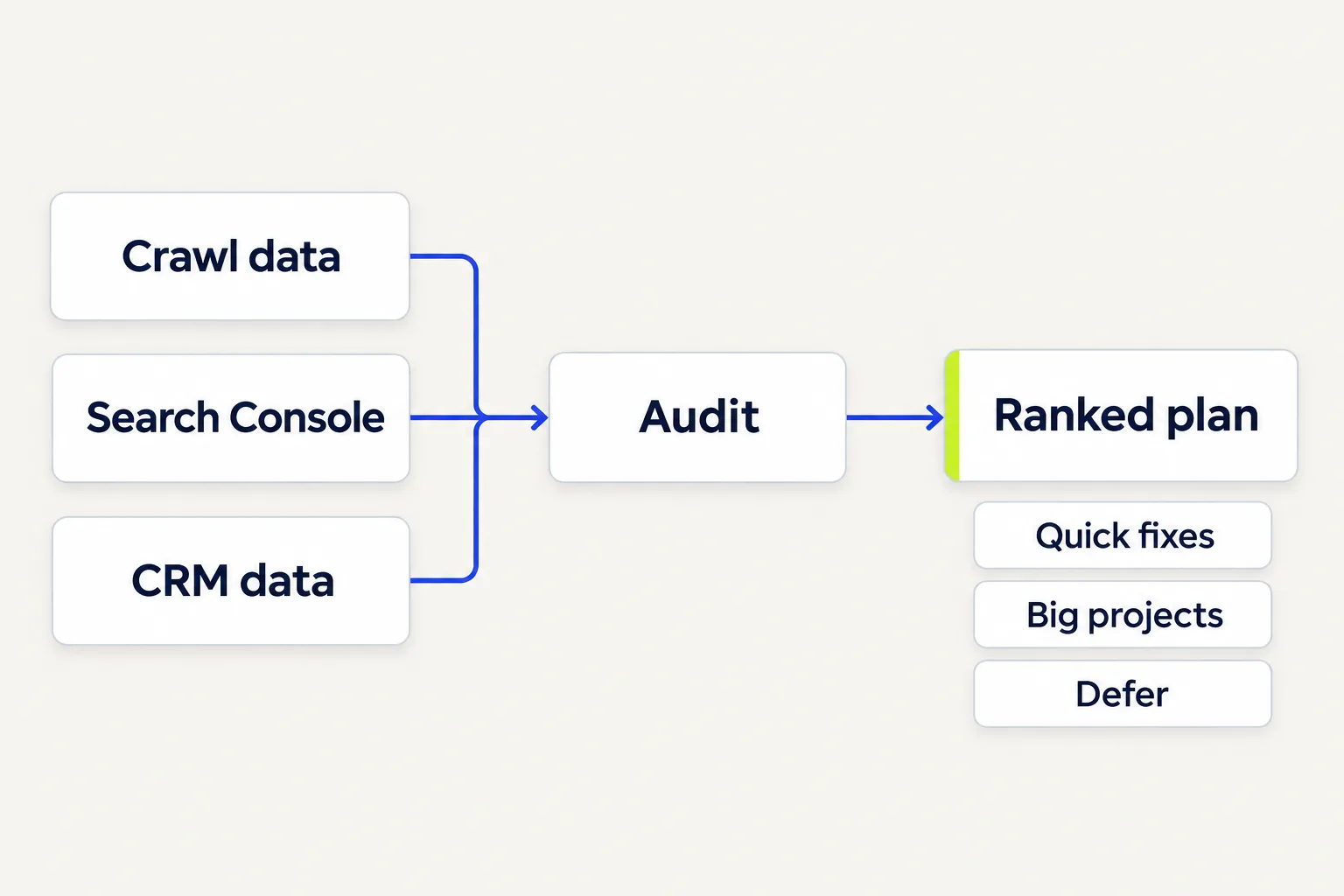
A useful ranking sorts each finding into one of three groups: quick fixes with clear value, larger projects with high value, and tasks to defer. Each line should read like a work order: the issue, the evidence, the proposed change, the owner, the effort and the reason it should lead to more qualified pipeline.
The plan then feeds your wider B2B SEO strategy. The audit says what is wrong and where the gaps are. The strategy decides which of those gaps to close first and how to keep closing them.
Doing it yourself or hiring someone
You can run the checklist above in-house if someone owns it and has access to the data. The crawl and the Search Console review are the easy parts. The hard parts are judgment calls: which gaps matter commercially, and which fixes are worth the developer time.
Hire an outside auditor when you lack the time, when you need an independent view, or when several teams must agree on priorities. Whoever does it, check these points before you commit.
- Ask for a sample deliverable. A real sample shows whether you get a plan or a data dump.
- Ask what access they need. A serious audit needs analytics and CRM context, not just a URL.
- Ask who does the work. Find out whether the person who audits your site is the person who explains it to you.
- Watch for generic output. A report that would fit any site in any industry does not fit yours.
- Watch for guarantees. No one can promise rankings or AI recommendations from an audit.
- Ask what happens next. The audit should end in decisions, not in a sales pitch.
Audit costs vary by scope and are covered in the B2B SEO pricing guide. For what an ongoing engagement includes after the audit, see B2B SEO services.
How often to audit
Sources disagree on a fixed schedule. One B2B guide recommends every three to six months (Sampression), while other guides suggest an annual audit with quarterly spot checks. A sensible rule is a full audit once a year and a lighter check each quarter, plus an extra audit after any of these events.
| Trigger | Why audit |
|---|---|
| Site migration or redesign | URL changes and template changes break indexing and links |
| Sharp drop in organic leads or traffic | You need the cause before you choose a fix |
| New product line or market | Existing pages and keyword maps no longer match the offer |
| Before a content or link campaign | Spend goes where gaps are largest |
| Core algorithm update with visible impact | Separates a site problem from a general shift |
Common mistakes to avoid
- Treating every warning as equal. A missing alt attribute on a blog image and a noindex tag on your main service page are not the same size of problem. Rank by commercial effect.
- Auditing only the blog. Educational posts are easy to review, but the pages that close deals decide the result. Start with the pages that sell.
- Skipping the sales team. Sales knows which questions buyers ask on calls and which objections stall deals. Those questions often point to missing pages.
- Chasing volume. A keyword list sorted by search volume will push you toward broad terms. Sort by fit with your buyer first.
- Ending with a report. An audit with no owner, no dates and no review turns into a file nobody opens. Schedule the first fixes before you close the meeting.
- Measuring only rankings. Check leads and sales conversations from organic search as well, even when the data is incomplete.
How Stijg Media handles audits
Stijg Media is a founder-led SEO and AI search agency that works with established B2B companies. Stijg Media does not sell a fixed audit package. Its site says each engagement is scoped individually and that no prices are published.
The starting point is what its home page describes as a free analysis with no obligation. You send your website and your growth goals. Stijg Media reviews how your business appears in Google and in AI search before the call, then walks through findings and priorities. The review covers the areas in this guide: technical SEO and site architecture, commercial pages, conversion paths and AI retrievability. The founder works directly with each client. Stijg Media does not state a turnaround time for the analysis, so ask when you reach out.
To start, send your site and goals through the form.
What an audit cannot do
- It does not fix anything. Results come from the work that follows it.
- It does not guarantee rankings, AI citations or leads.
- It cannot make attribution perfect. Long B2B cycles and several contacts per account blur the numbers.
- It goes stale. A site changes, and so do search results, so treat the plan as a snapshot to revisit.
Used well, a B2B SEO audit tells you where organic search is losing buyers and which fixes deserve your next quarter. If you want a second view on your own site, you can tell Stijg Media what you sell and where you are stuck.
Frequently asked questions
What is included in a B2B SEO audit?
A B2B SEO audit usually covers technical health and indexation, keyword and intent coverage, bottom-of-funnel pages, content quality, backlinks and internal links, conversion tracking, and visibility in AI answers. The output should rank findings by likely effect on qualified leads and name an owner and effort for each one.
How is a B2B SEO audit different from a regular SEO audit?
A regular audit checks whether a site can be crawled, indexed and ranked. A B2B audit adds buying-committee coverage, long-journey content, money-page inventory and a check that organic visits can be traced to leads and pipeline in the CRM. It prioritizes by revenue potential, not search volume.
How often should a B2B company run an SEO audit?
Sources differ. One B2B guide suggests every three to six months, while others suggest an annual audit with lighter quarterly checks. A practical rule is a full audit each year, quarterly spot checks, and an extra audit after a migration, redesign, new product line or sharp drop in organic leads.
Can I do a B2B SEO audit myself?
Yes, if someone owns the work and has access to Search Console, analytics and CRM data. The crawl and data review are straightforward. The harder part is judging which findings matter commercially and which fixes justify developer time. An outside view helps when teams disagree on priorities.
Does an SEO audit include AI search visibility?
It should. Google says AI Overviews and AI Mode need no special optimization beyond being indexed and snippet-eligible, so the audit checks raw-HTML content, entity consistency and whether AI answers mention or cite your brand for a fixed set of buyer questions. Mentions are a signal, not leads.