
AI search for B2B means buyers use ChatGPT, Google AI Overviews, AI Mode, Perplexity and Copilot to research vendors, and those tools name a handful of companies in the answer. You get named when your site states clear facts, answers buyer questions in the first sentence, and is confirmed by other sources. It is an extension of B2B SEO agency work, not a replacement for it.
- Buyers use generative AI during purchasing. Forrester's 2024 survey found 89% used it in at least one area of the process.
- Google says there are no extra technical requirements for AI Overviews and AI Mode beyond being indexed and eligible for a snippet.
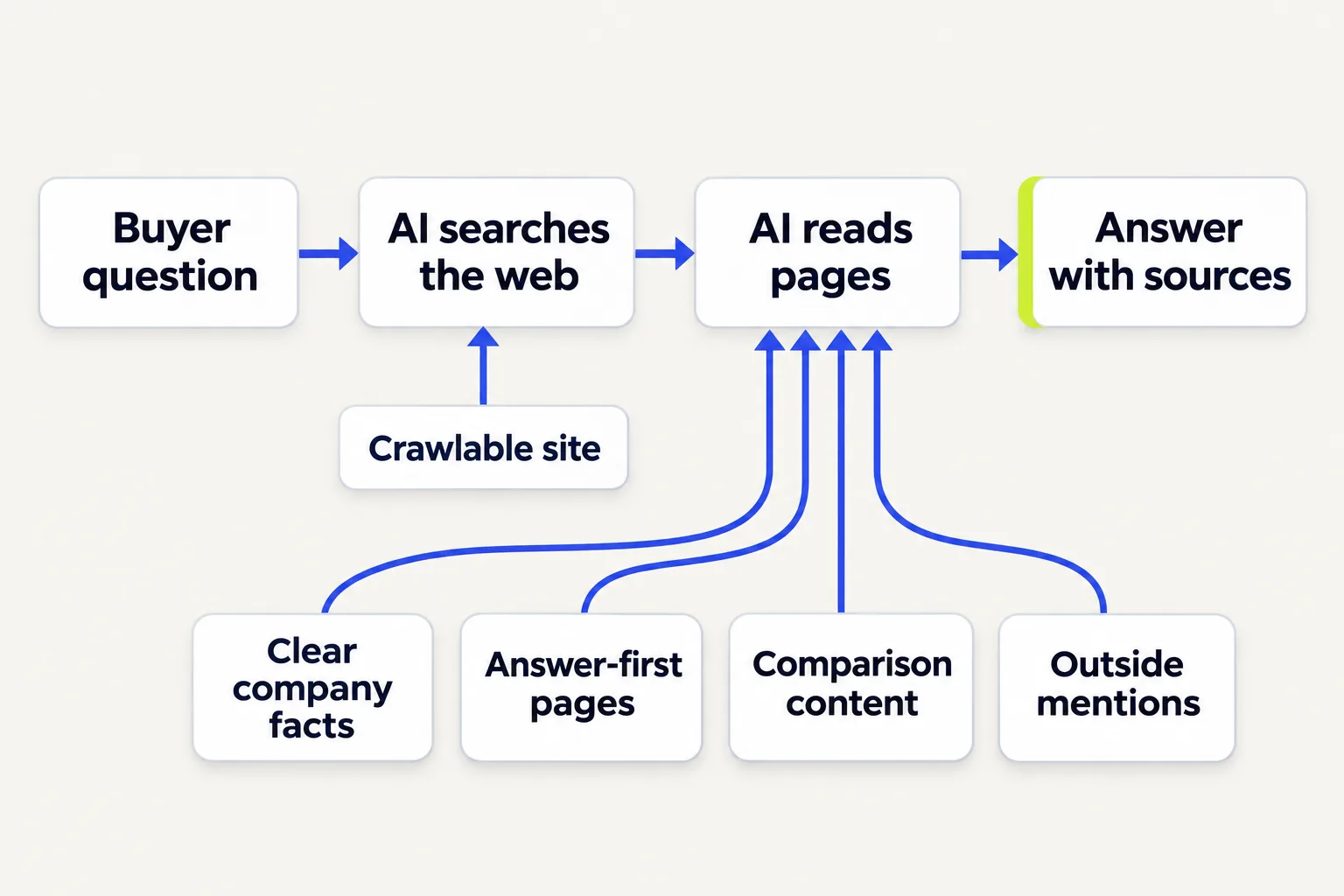
- The work that helps is plain: clear entity facts, answer-first pages, comparison content, third-party mentions and crawl access.
- AI answers change with the wording of the question, so measure a fixed set of prompts over time, not one screenshot.
- AI referral traffic is still small on average. Judge this work by shortlist presence and pipeline, not visits alone.
What AI search for B2B means
AI search is any search experience where a model writes the answer and cites sources: Google AI Overviews and AI Mode, ChatGPT with web search, Perplexity, Microsoft Copilot. For a B2B company the question is simple. When a buyer asks one of these tools "who makes X" or "which vendors do Y", is your company in the answer, and is the description correct?
Several names cover the same work. Generative engine optimization (GEO) and answer engine optimization (AEO) both describe making a site easier for AI tools to retrieve, understand and cite. "AI SEO" is the looser label. This guide uses "AI search" for the channel and GEO for the practice. The tactics are close to good SEO with a sharper focus on facts, structure and outside confirmation. The next section looks at why B2B differs from consumer search.
How B2B buyers use AI search
B2B buying is research-heavy, involves several people and runs for months. AI tools fit that: a buyer can ask for a category overview, a shortlist and a risk check in one sitting. The sourced evidence is thinner than vendor blogs suggest, so the table below holds only figures traced to a page fetched for this guide.
| Finding | Source and date | What it does not show |
|---|---|---|
| 89% of buyers reported using generative AI in at least one area of their purchasing process. | Forrester blog post on its 2024 Buyers' Journey Survey, published November 21, 2024. | How often, at which stage, or whether AI picked the vendor. The post does not state a sample size. |
| Almost two-thirds of buyers use generative AI tools as much as, or more than, traditional search. Use is highest in the stages that take longest. | Responsive, Inside the B2B Buyer's Mind 2025, Fall 2025. Responsive sells RFP software. | Sample size and method sit in a gated report I could not read. |
| In 95% of cases the winning vendor was already on the buyer's Day One shortlist. | 6sense 2025 B2B Buyer Experience Report, nearly 4,000 buyers, global. | 6sense does not tie this to AI use. It describes how deals are decided. |
| AI referral traffic was 0.25% of a site's total traffic on average, across 81,947 sites. | Ahrefs, published June 26, 2025. | AI Overviews and AI Mode clicks count as "Search" in that data, so AI-driven visits are probably undercounted. The data is not B2B-only. |
Read these together. Buyers do use AI in research, and deals tend to go to a vendor who was in the buyer's head early. Direct visits from AI tools are still a small slice. The value is in being named, not in the click.
What buyers ask at each stage
The prompts differ by stage, and so does the page that should answer them. Use this as a starting map for your prompt set and your content gaps.
| Stage | Example prompt | Page that answers it |
|---|---|---|
| Define the problem | "Why do our sensors drift after a year of use?" | Plain explainer by a named expert, with the problem defined in the first sentence. |
| Compare approaches | "Hosted or on-premise for a mid-size finance team?" | Comparison page with criteria, trade-offs and who each option suits. |
| Build a shortlist | "Which vendors serve mid-size manufacturers in the US?" | Product or service page with clear facts on who it serves, plus outside reviews and listings. |
| Check risk | "What do customers say about implementation time?" | Implementation page with steps and limits, plus third-party reviews. |
The example prompts are illustrations, not measured queries. Replace them with the wording your own sales team hears on calls.
What Google says about AI features
Google's documentation on AI features in Search states that to be a supporting link in AI Overviews or AI Mode, a page must be indexed and eligible to be shown in Google Search with a snippet. It adds that there are no additional requirements, no special optimizations necessary, no need for new machine-readable files or AI text files, and no special schema.org markup. The source is Google Search Central, read on November 24, 2026.
The same page says both features may use "query fan-out": several related searches across subtopics and data sources. That matters for B2B. One buyer question can trigger searches for your category, your use case, your integrations and your reviews. A site that covers those subtopics gives the system more pages to pick from.
This is Google. ChatGPT, Perplexity and Copilot have their own retrieval and no equivalent public statement of this kind. Treat Google's page as a floor: your pages must be crawlable, indexable and snippet-eligible. Everything after that is about being the clearest, best-confirmed answer.
Why the shortlist is the prize
If 95% of winners were on the Day One shortlist, as 6sense reports, then the job of any early research channel is to put you on that list. AI tools now build shortlists in front of the buyer: "list the best vendors for X for a company like mine". A vendor missing from that answer starts behind.
This also explains why AI answers are unstable. Stijg Media published a small prompt-wording study on November 19, 2026 (answers collected November 18 and 19). It asked one model with web search, through an API, three differently worded questions about AI SEO agencies, ten times each, for 30 answers. Broad requests produced lists averaging 7.9 names. A shortlist request for an established US B2B service company with a lean team averaged 5.1. Across all 30 answers 44 different agencies appeared, and only 7 appeared under all three wordings. For the B2B-worded question most of the model's searches included the word "B2B", and no single cited page appeared in more than 3 of 10 answers.
The study has limits and says so: three wordings rather than a controlled test, ten answers each, one model through an API rather than the consumer app. It does not rank anyone. Its lesson is narrow and useful: a B2B buyer's wording changes who gets named, so being present for one prompt tells you little.
What gets a B2B company into AI answers
No one outside the AI companies knows the full selection logic, and any guide that claims a formula is overselling. What follows is the set of practices that match Google's stated requirements and the way retrieval systems read pages. Each one is also good for human buyers.
1. State clear entity facts
An AI tool has to work out what your company is, what it sells, who it serves and where it operates. Put those facts in plain text on your own site: a short company description, a page per product or service, who it is for, the industries and regions served, and named people with their roles. Use the same wording on your site, your LinkedIn page and your profiles on review sites. A mismatch, such as a different category name in each place, makes the entity harder to resolve.
Include facts that a model can quote whole: what the product does, what it integrates with, which standards or certifications apply, the size of company you serve. Do not publish a claim you cannot support. A wrong or inflated fact gets repeated just as readily as a correct one.
2. Write answer-first pages for the questions buyers ask
Buyers ask comparison and risk questions: how does X differ from Y, what does implementation involve, what are the alternatives, what could go wrong. Give each question a heading, answer it in the first sentence, then add the detail. A page that opens with preamble makes the answer harder to lift and harder for a busy reader to find.
Make each section understandable on its own. A passage that depends on "as mentioned above" breaks when it is quoted alone. Name the subject in the passage rather than relying on a pronoun from three paragraphs earlier.
3. Publish honest comparison and evaluation content
Mid-funnel prompts ask for comparisons and shortlists. Pages that compare approaches, list selection criteria and say who a product is not for give the system material to work with. They also earn trust from readers. Write them with the same standard you would use for a buyer: state limits, name trade-offs, and avoid claims no one can check. A page that only praises your own product reads as advertising to people and to retrieval systems.
4. Earn confirmation outside your site
AI tools cross-check. Your own site says what you are; independent pages say whether that is believable. For B2B that means customer reviews on the platforms your buyers use, trade publication coverage, analyst or association listings, partner directories, podcasts and credible mentions in industry discussions. This is the same work as link building and digital PR, judged by whether a buyer would trust the source, not only by link metrics. It is slow and cannot be faked at scale.
5. Keep your content crawlable and indexable
Check that robots.txt and your firewall do not block the crawlers you want, that key pages are in the HTML and not hidden behind scripts or gated forms, and that pages return normal status codes. Structured data that matches visible content is fine for machines reading the page, but per Google it is not required for AI features. If a page cannot be fetched, none of the rest matters.
How AI search fits inside a B2B SEO program
AI search does not replace search. Google's AI features pull from pages that are indexed and snippet-eligible, so the technical and content base of SEO is the entry ticket. The shift is in emphasis, as the table shows.
| Area | Stays the same | Changes or is added |
|---|---|---|
| Technical | Crawlability, indexation, speed, clean architecture. | Check access for AI crawlers and that key facts sit in the HTML. |
| Keywords | Commercial pages for the terms buyers search. | Add a set of full-sentence buyer prompts, grouped by stage. |
| Content | One page per intent, written by someone who knows the subject. | Answer-first sections, comparison pages, clear entity facts. |
| Authority | Links from relevant sites. | Reviews, listings, mentions and consistent descriptions across sources. |
| Measurement | Rankings, organic leads, pipeline. | Mention, citation and accuracy tracking across a fixed prompt set. |
That is why this topic sits inside a full B2B SEO strategy and not beside it. If you are weighing what an agency should deliver across both, see how B2B SEO services are scoped. If you suspect your own site has gaps in access, structure or entity facts, a B2B SEO audit is where to find them.
How to measure AI search visibility
Do not measure with a single query typed into one tool. Answers vary between runs and between wordings. Use a repeatable method.
- Build a prompt set. Write 30 to 60 prompts a buyer might use, grouped by stage: define the problem, compare options, build a shortlist, check risk. Include wording from different roles, such as a technical evaluator and a finance approver.
- Run them on a schedule. Use the same tools, the same settings and the same cadence. Record the date, the platform and whether web search was on.
- Log what happens. For each answer note whether you are mentioned, whether you are recommended, which sources are cited, who else appears and whether the description of you is correct.
- Use platform data where it exists. Microsoft introduced AI Performance in Bing Webmaster Tools in public preview on February 10, 2026. It reports total citations, average cited pages, grounding queries and page-level citation activity across Copilot and Bing AI summaries. Bing says grounding queries are a sample, and that citation counts do not show placement or importance.
- Check analytics. Tag referrals from AI tools in your analytics and ask new leads how they found you. Expect small counts. As noted above, AI Overview and AI Mode clicks may sit inside "Search" data.
- Connect to pipeline. Where your CRM allows, follow those leads through opportunity and closed revenue. A mention is not a lead and a citation is not revenue.
Treat results as a trend, not a score. A single prompt flipping between runs is noise. A set of 40 prompts moving over three months is a signal.
A first 90 days for a small team
- Weeks 1 to 2: baseline. Build the prompt set, run it, and record where you appear and what is said about you. Check crawler access and indexation of your key pages.
- Weeks 3 to 6: fix the facts. Correct and align your company description, product pages and profiles. Add the missing answer-first sections to your top commercial pages.
- Weeks 5 to 10: fill the gaps. Publish the comparison and evaluation pages your prompts expose as missing. Ask customers for reviews on the platforms buyers use.
- Weeks 8 to 12: re-run and decide. Run the same prompts. Keep what moved the results, drop what did not, and set the next quarter's priorities.
Treat the timing as a plan, not a promise. Retrieval and ranking systems change, and third-party mentions take longer than on-site fixes.
Common mistakes
- Chasing one prompt. One answer is an anecdote. The Stijg Media study above shows how much wording moves who is named.
- Rewriting the whole site for AI. Google says no special optimization is needed. Fix the pages that matter most for buyers first.
- Treating schema as a switch. Markup should describe what is on the page. It is not a guarantee of being cited.
- Using AI to mass-produce pages. More pages with the same thin facts do not add anything a buyer or a retrieval system can use.
- Ignoring accuracy. A model can describe your company wrongly. Log errors and fix the sources they come from.
- Dropping classic SEO. The pages that AI features cite must first be indexed and eligible in Search.
How Stijg Media handles AI search
Stijg Media is a founder-led SEO and AI search agency that works with established B2B companies. On its own site it describes a repeating cycle: map queries and prompts, set a baseline, improve owned assets, strengthen authority, measure, and iterate. It tracks AI visibility against a fixed set of commercially relevant buyer prompts and records mentions, recommendations, citations, sources and which competitors appear. It does not guarantee rankings or ChatGPT recommendations, and it scopes each engagement to the client. The promise is strategy through implementation, without the handoffs.
If you want a view on where your company stands in Google and in AI answers, you can ask Stijg Media for a plan. The reply says whether Stijg Media is the right fit.
Sources and dates
Every external figure on this page comes from a page fetched on November 24, 2026. That includes Stijg Media's own study.
- Forrester, "The Future Of B2B Buying Will Come Slowly, And Then All At Once", November 21, 2024.
- Responsive, Inside the B2B Buyer's Mind 2025, Fall 2025.
- 6sense, 2025 B2B Buyer Experience Report, publication date not stated on the page.
- Ahrefs, "AI Traffic Has Increased 9.7x in the Past Year", June 26, 2025.
- Google Search Central, AI features and your website, no update date shown on the fetched copy.
- Bing Webmaster Blog, Introducing AI Performance, February 10, 2026.
- Stijg Media, prompt-wording study, November 19, 2026.
Frequently asked questions
Is AI SEO different from regular B2B SEO?
It builds on it. Google says pages must be indexed and eligible to show with a snippet to appear in AI Overviews and AI Mode, so the technical and content base still matters. What is added is attention to clear entity facts, answer-first sections, comparison content, outside confirmation and a separate way to measure mentions and citations.
What is the difference between GEO and AEO?
The terms overlap and are used loosely. Generative engine optimization (GEO) usually means making content easy for AI tools to retrieve, understand and cite. Answer engine optimization (AEO) usually means structuring content to answer questions directly. For a B2B company the practical work is the same, so pick one label and be consistent.
Do I need special schema markup to appear in AI answers?
Not for Google. Its documentation on AI features says there are no additional requirements, no special optimizations, and no special schema.org markup needed. Structured data is still fine when it matches the visible page, but treat it as a helper for machines, not a ticket into AI answers.
Can anyone guarantee that ChatGPT will recommend my company?
No. AI answers change between runs and with the wording of the question. Stijg Media's own prompt-wording study found that three differently worded questions to one model produced different shortlists. Any agency promising a guaranteed recommendation is promising something outside its control.
How do I measure AI search visibility?
Build a fixed set of 30 to 60 buyer prompts, run them on a schedule, and log whether you are mentioned, recommended and cited, which sources appear and whether the description is correct. Add platform data such as Bing's AI Performance report, check analytics for AI referrals, and follow leads through to pipeline.
How long does AI search work take to show results?
No source measured this for B2B, so no honest number exists. On-site fixes can show up in your prompt set within weeks if the pages get re-crawled. Reviews, listings and third-party mentions take longer. Judge the work on trends in a fixed prompt set over several months.