
A good B2B SaaS SEO agency builds the pages software buyers search for (comparisons, alternatives, integrations, use cases, product pages), ties its work to signups, demos and pipeline, and fits your stage and budget. Rankings and traffic alone are not the test. This page explains what B2B SaaS SEO needs, how to match an agency to your stage, and how Stijg Media approaches software companies.
- B2B SaaS SEO differs from general B2B SEO agency work mainly in page types and measurement: product-led pages, comparison and integration content, and signup or demo attribution.
- Judge an agency on whether it reports demos, trials and pipeline, not only sessions and rankings.
- Budgets vary widely and quotes are not like-for-like. Compare scope and reporting before you compare price.
- Stijg Media works with software and technology companies but does not name a SaaS client on its site. This page says so plainly.
What does B2B SaaS SEO need that other B2B SEO does not?
B2B SaaS SEO needs content built around the product and the alternatives buyers compare, plus tracking that follows a visitor to a signup or a demo request. A manufacturer or a consultancy sells through a quote or a call. A software company often sells through a trial, a free tier or a demo, and buyers compare several tools in the same session.
That changes what an agency must build. The table shows the page types that matter most for software, and why each one earns its place.
| Page type | What the buyer is doing | What the agency must handle |
|---|---|---|
| Comparison pages ("Your product vs Competitor") | Choosing between two named tools | Fair, accurate claims; a clear next step; regular updates when products change |
| Alternative pages ("Competitor alternatives") | Leaving a tool or building a shortlist | Honest fit notes for different buyers, not a list that always ends with you |
| Integration pages | Checking that the tool works with their stack | One page per integration with setup detail, not thin templates |
| Use-case and role pages | Finding a tool for a specific job or team | Language that matches how the buyer describes the problem |
| Product and pricing pages | Deciding whether to try it | Technical health, clear copy, and a signup or demo path that tracks cleanly |
| Educational content | Learning the problem before looking for a tool | Topics that lead to the product, not traffic that never converts |
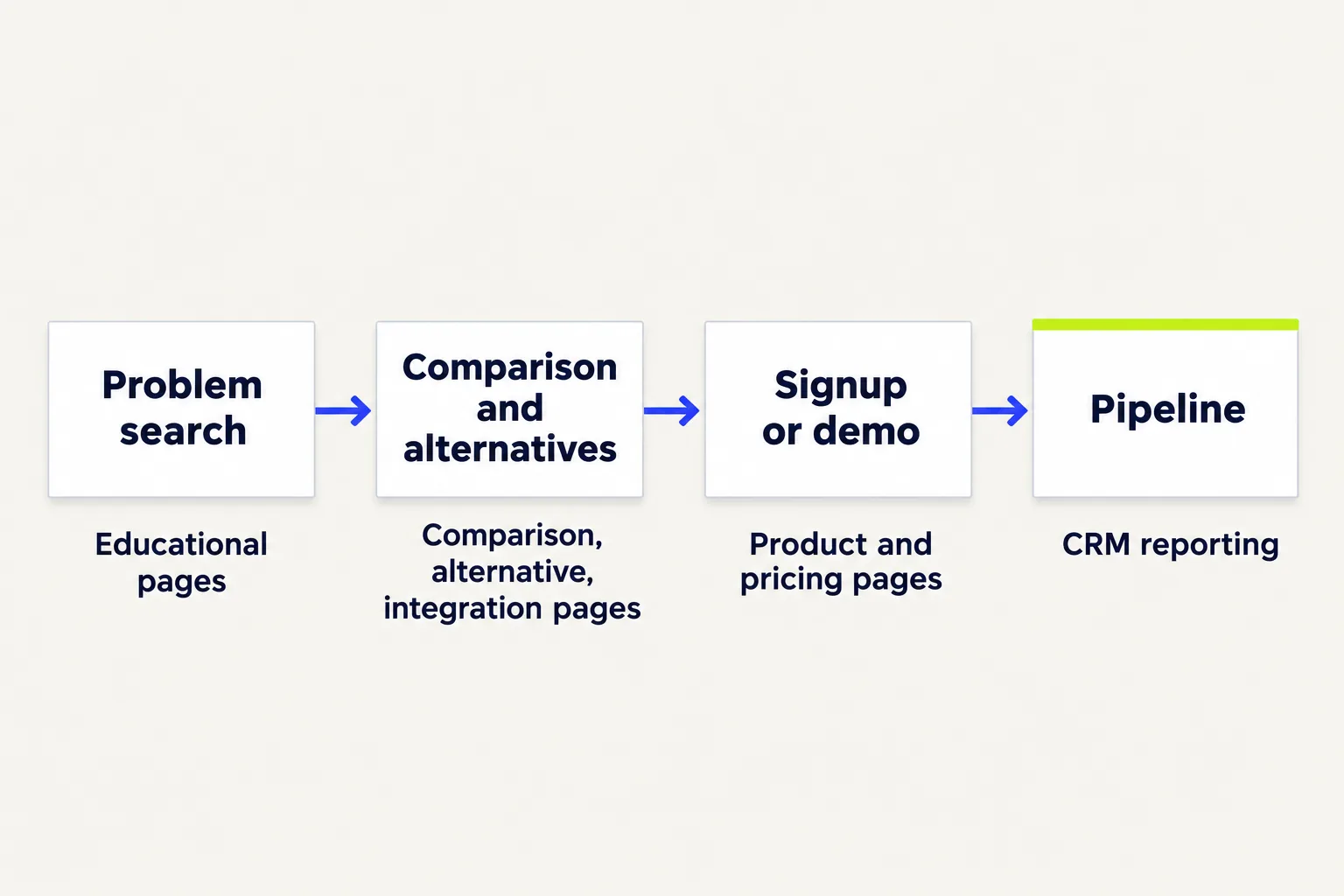
The common point is that a software company's search work should end in a measurable commercial event. Prioritize keywords by buying intent, and grade the work on pipeline added, not on keywords or traffic.
How should a SaaS SEO agency measure results?
A SaaS SEO agency should report the events your business counts as progress: trial signups, demo requests, qualified leads and pipeline, not only rankings and organic sessions. Traffic that never reaches a signup is a weak result for a software company.
Ask for the reporting before you sign. A sound report separates branded from non-branded search, shows signups and demo requests by landing page, and connects those events to your CRM where the data allows. Agencies differ here: some stop at the form fill, others follow the lead to closed revenue. If your sales cycle is long, ask how the agency reports on the months before a deal closes.
AI search belongs in the report too. Buyers now ask AI tools for software recommendations, and many agencies now list AI search (often called GEO) as a service. Ask how the agency checks whether your product appears in those answers, and how it separates that from ordinary rankings. For the wider picture of what a B2B SEO retainer includes, see B2B SEO services.
Which agency type fits which stage?
The right agency depends on your stage, your team and your budget more than on any ranking list. This is an editorial framework, not a rule, and the fit notes use only what the agencies say about themselves.
| Your situation | What usually fits | Watch for |
|---|---|---|
| Early stage, one marketer, no content team | A narrow engagement: a strategy phase or a short program with no lock-in | Long contracts before any result is visible |
| Product-market fit, a content team in place | An agency that plans and builds the SEO program and works with your writers and developers | Strategy documents that nobody implements |
| Funded growth stage with a sales team | A larger, multi-channel team or a specialist that reports to pipeline | Reports that stop at traffic |
| Established company, mixed products, long sales cycle | A team that can work across product lines, and tie work to CRM data | Packages that ignore your sales cycle |
Budget shapes this more than most buyers expect. Published prices for SaaS SEO range from a few thousand dollars for a strategy phase to six figures a year, and the scopes are very different. For help on weighing price against scope, read B2B SEO pricing, and for a full vetting process see how to choose a B2B SEO agency.
How Stijg Media approaches a SaaS engagement
Stijg Media runs fully implemented SEO and AI SEO campaigns for established B2B companies. Our B2B SEO page says the approach is built for SaaS and professional services companies, and that we work with SaaS, software, technology and hardware businesses. The industries we have served so far are electronics and security hardware, food-service equipment, commercial landscaping and political canvassing services. We do not name a SaaS client and we do not claim a SaaS specialty.
Our process maps the queries and AI prompts buyers use, sets a baseline, improves the owned pages, builds authority through links and third-party mentions, then measures and repeats. For a software company, that starts with comparison, integration and product pages and with how signups and demo requests are tracked. We tie results to leads, opportunities, pipeline and revenue where your CRM data allows. Scope is custom and we publish no prices. If you want a plan for a software product from a founder-led team that implements the work itself, tell us about your product. If you need a team with a long public list of SaaS clients, a SaaS-only specialist is the better place to start.
What should you ask a SaaS SEO agency before you sign?
Ask for specifics, because a SaaS SEO pitch can sound alike from one agency to the next. These questions separate the agencies that can do the work from the ones that can describe it.
- Which page types will you build for us first, and why? A good answer names comparison, integration or use-case pages tied to your product, not only blog topics.
- What will you report, and where does the data come from? Look for signups and demo requests by landing page, and CRM data for pipeline.
- Who writes the content, and who understands the product? Product-led pages written without product knowledge read as generic.
- What do you ask us to provide? Developer time, product access and subject-matter interviews all affect speed.
- How do you handle AI search? Ask how it is checked and what happens when the answers change.
- What are the terms? Some agencies on this list state month-to-month or no lock-in terms. Others do not say.
- Who will we actually work with? Ask whether the people in the sales call do the work.
The full vetting process, including red flags and contract terms, is in how to choose a B2B SEO agency.
What mistakes do SaaS companies make when they hire for SEO?
The most common mistake is hiring for traffic. A software company can double its organic sessions and see no change in signups when the new traffic comes from topics far from the product. The fix is to set the target as signups, demo requests or pipeline from the start, and to agree how each is counted.
A second mistake is skipping the product pages. Many SaaS blogs publish dozens of articles while the product, pricing and integration pages stay thin. Those pages are where a buyer ends up when ready to decide, and they need the same care as the blog.
A third is treating comparison pages as sales copy. A page that claims to beat every rival on every point is easy for a buyer to dismiss, and it ages quickly as products change. Fair comparison pages with clear fit notes earn more trust, and they need a regular review.
A fourth is measuring only the last click. A buyer may read an article, return through a branded search a month later and then ask for a demo. If the report credits only the final click, the content that started the journey looks worthless. Ask how an agency treats assisted conversions.
A fifth is choosing on a ranking list without checking who wrote it. Many "best SaaS SEO agency" lists are published by agencies that place themselves first. Check any list the same way: who wrote it, what do they sell, and where do the facts come from?
Does self-serve or sales-led SaaS change the SEO plan?
Yes. The sales motion decides which conversion the agency optimizes for and which pages carry the most weight. Self-serve SaaS and demo-based SaaS are different jobs, and a plan built for one rarely suits the other.
In a self-serve product, the visitor can start a trial or a free plan without talking to anyone. Search work centers on the pages that lead to that signup: comparison and alternative pages, use-case pages and product pages, with the signup path kept short. Reporting centers on signups by landing page and, later, on how many of those users become paying accounts.
In a sales-led product, the visitor books a demo or fills in a contact form, and a salesperson takes over. Search work still covers the same page types, but quality of the lead matters more than volume. Reporting should show which pages and queries produce demo requests that sales accepts, and how many of those reach a deal. That needs the agency and the sales team to agree on what a qualified lead means, and it needs CRM data to be reachable.
Many companies run both: a free tier for small teams and a sales-led plan for larger ones. In that case ask the agency how it separates the two audiences, because the buyer for a free plan and the buyer for an annual contract search differently and need different pages.
How does AI search change B2B SaaS SEO?
AI search adds a second place where buyers meet your product: the answer an AI tool gives when someone asks for a software recommendation. Many agencies now describe AI search or GEO as a core service, so ask what the work includes and how it is measured.
For a software company, the practical work overlaps with classic SEO: clear product pages, accurate comparison and integration content, and mentions on third-party sites that describe what the product does. The difference is in measurement. An agency should be able to say which buyer questions it checks, how often, and what it does when your product is missing or described wrongly. Treat any agency that promises a fixed result in AI answers with caution, since the tools change their answers and no agency controls them. Stijg Media's own site, for example, says it does not guarantee rankings or ChatGPT recommendations.
What to settle internally before you contact agencies
Agencies work faster and quote more accurately when you arrive with a few answers ready. Decide which conversion event counts: a free trial, a demo request, a contact form or a purchase. Know where that event is tracked today and whether it reaches your CRM. List the five to ten competitors your buyers compare you with, since comparison and alternative pages start there.
Name who will approve content and who will implement site changes. Many SEO programs slow down because a developer or an approver is not available, not because the plan is weak. Agree a budget range before the first call, because the published prices in this list differ widely and scope is the main reason.
Finally, decide how you will judge the first three months. Early results in SEO are usually leading indicators, such as pages published, indexing, rankings for target queries and first signups, rather than pipeline. Agree on which indicators count at 30, 60 and 90 days, and when the harder pipeline numbers should appear. Timelines differ, so ask each agency to put its timeline in writing, and be wary of anyone who promises pipeline in 30 days. For a broader look at agency selection across all B2B segments, return to our B2B SEO agency page.
Summary
B2B SaaS SEO is B2B SEO with software-specific page types and tracking tied to signups and demos. Pick an agency by how it builds those pages, how it reports, and whether its terms and price fit your stage. Verify every claim in a call and in writing before you commit. If you would like a founder-led team to look at your product, send us the details.
Frequently asked questions
What does a B2B SaaS SEO agency do?
It plans and builds the search pages a software buyer uses: comparison, alternative, integration, use-case and product pages, plus educational content. It fixes technical issues, builds authority through links and mentions, and reports on signups, demo requests and pipeline. Many also cover AI search visibility. Scope and reporting differ by agency, so ask for both in writing.
How is SaaS SEO different from other B2B SEO?
SaaS SEO leans on product-led pages, comparisons against named competitors and integrations, and it tracks signups and demo requests rather than only form fills. Software buyers often trial a tool before talking to sales, so attribution matters more. Other B2B segments, such as manufacturing, sell through quotes and longer relationship cycles and need different pages.
How much does a B2B SaaS SEO agency cost?
Published prices vary widely and are not like-for-like. Some agencies quote a few thousand dollars for a strategy phase, others start at six figures a year for full-service work, and many state no prices. Stijg Media sets scope per engagement and publishes no fixed prices. See the B2B SEO pricing guide for how to compare scopes.
Should a SaaS company hire a specialist or a general B2B SEO agency?
A specialist brings software page types and examples. A general B2B agency may bring broader channel experience and fit a company with several product lines or industries. Decide on what each can show about your stage, how it reports, and who does the work. Neither type is better by default, so ask both for the same details.
How long does B2B SaaS SEO take to show results?
Timelines differ by agency, site and competition, so ask each one to state theirs in writing. Early signs are usually pages published, indexing and rankings for target queries, while pipeline comes later. Be wary of anyone who promises pipeline in 30 days.