
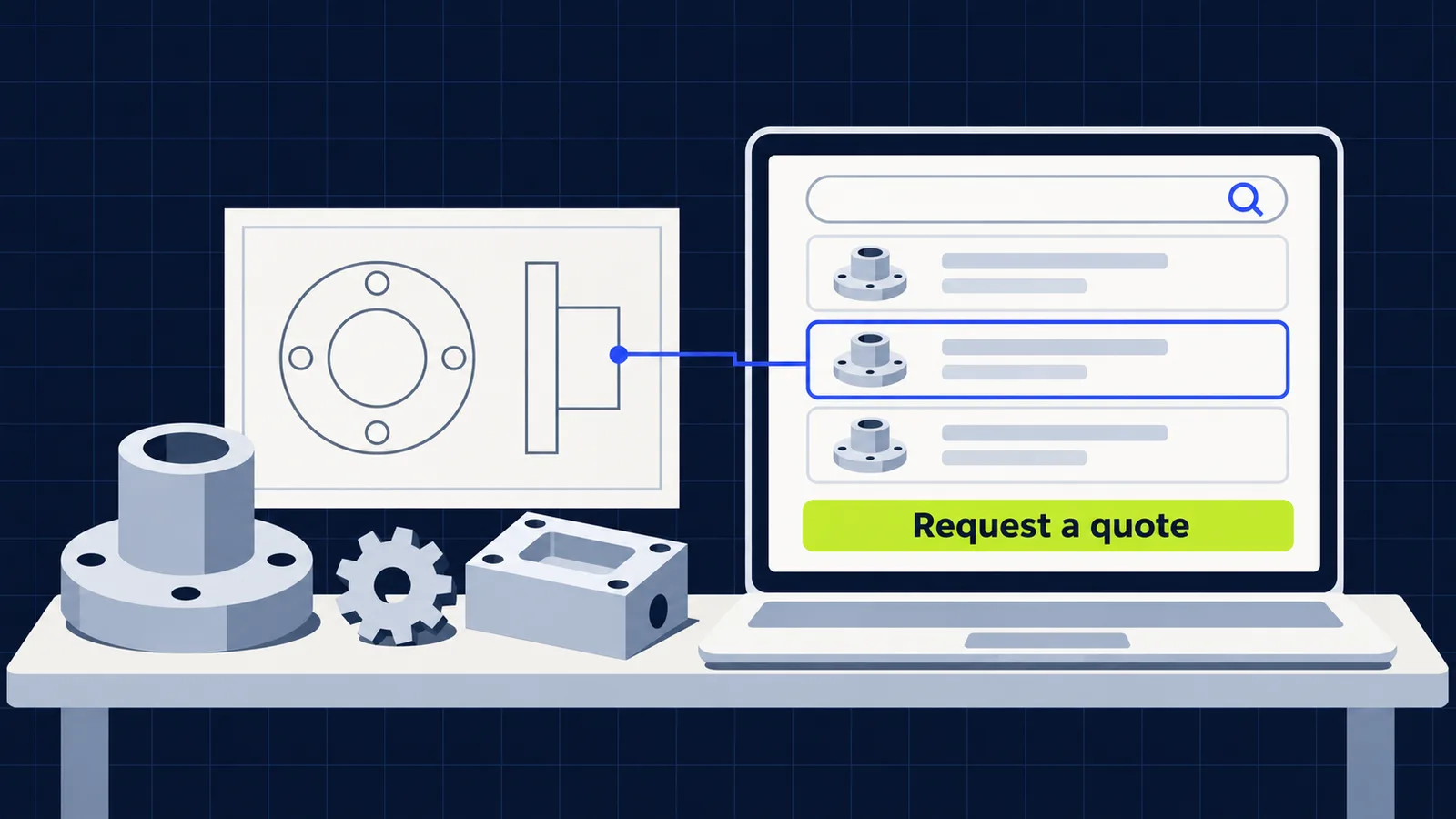
Manufacturing SEO is the work of making a manufacturer or industrial supplier findable for the searches engineers, buyers and procurement teams run before they send a request for quote (RFQ). It focuses on part numbers, specifications, capabilities, certifications and the technical documents buyers need, and it is measured in RFQs, not traffic.
- Industrial buyers search in specifications and part numbers, so rankings come from precise pages, not broad terms.
- Catalog structure, technical documents and distributor listings decide whether your own pages can rank for your own products.
- Search volume in this niche is small. The value sits in a few high-intent queries, so measure RFQs, not sessions.
- Stijg Media has no manufacturing case studies to show. This page explains the method and where it fits, and says so plainly.
What manufacturing SEO is
Manufacturing SEO applies the same search principles as any B2B SEO agency engagement, with one difference: the products are technical and the people searching know exactly what they need. A buyer types a material, a tolerance, a standard or a part number, not "best supplier."
Three things set it apart from general B2B SEO:
- Specific queries. Searches name processes, materials, certifications and part numbers.
- Several people decide. An engineer specifies, procurement compares, and a manager approves. Each looks for different content.
- The sale happens off the site. The website's job is to start an RFQ or a sales conversation. It rarely closes a sale itself.
Google's AI Overview for "manufacturing seo" describes the work in much the same way: ranking for technical queries, part numbers, capabilities and compliance standards (observed in a live search for this page, November 2026). If your pages answer those queries in plain, checkable detail, they have a better chance of ranking and of being cited.
How industrial buyers search
Group your searches by what the buyer already knows. Each group needs a different page.
| Query type | Example | Buyer knows | Page that fits |
|---|---|---|---|
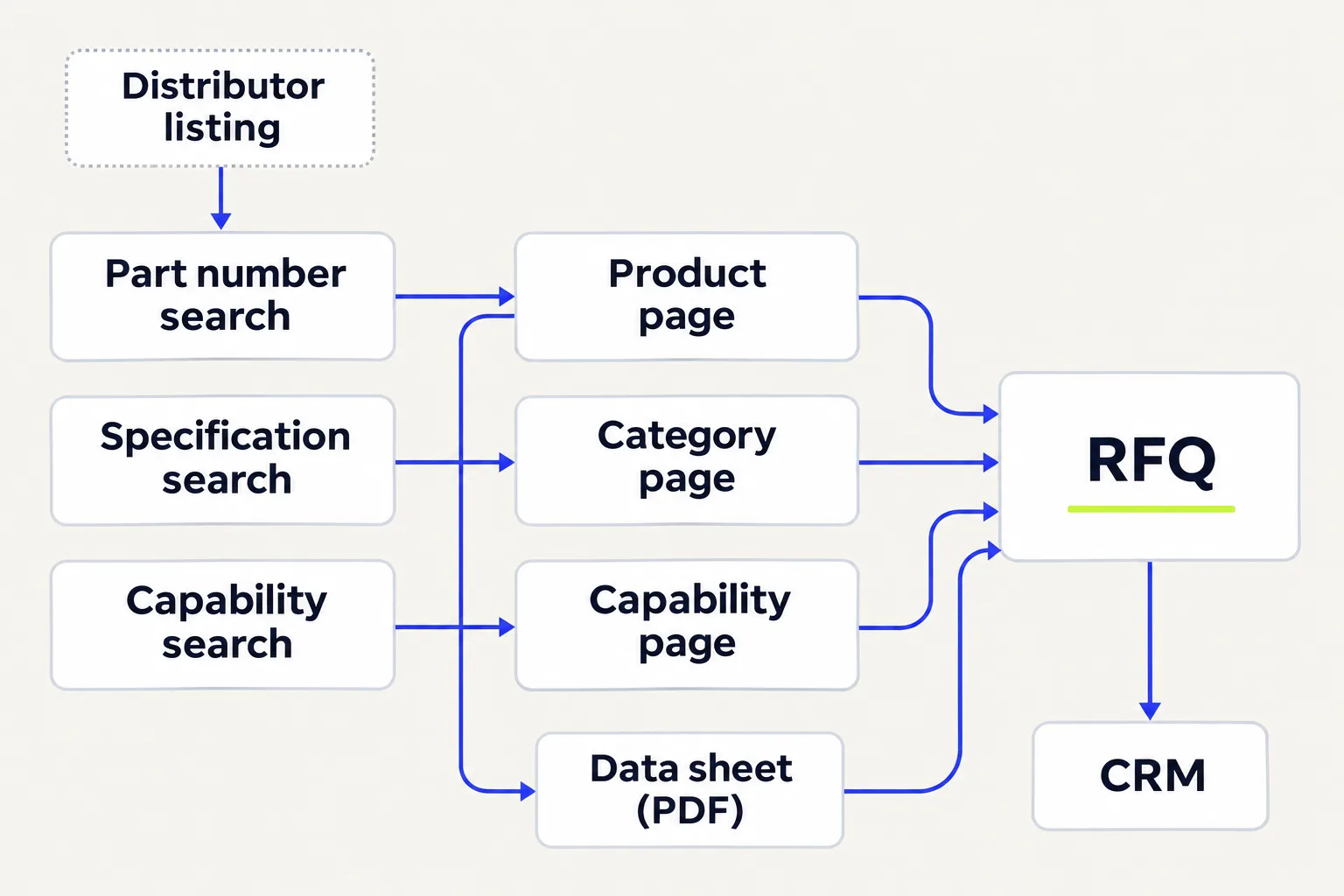
| Part number | a manufacturer part number or SKU | Exactly which item | Product page with specs, data sheet and RFQ button |
| Specification | a material, size or tolerance | The requirement | Product family or category page with filters that match specs |
| Capability | a process plus a material | The method, not the supplier | Capability page with equipment, limits and sample parts |
| Application or industry | a part type for a named sector | The use, not the product | Industry page linking to products and standards |
| Certification | a quality or compliance standard | The compliance bar | Certification page with scope, certificate details and audit dates |
| Comparison or problem | one process versus another | A decision to make | Technical article that ends at a relevant capability page |
Most manufacturers already hold this data in catalogs, quote sheets and engineering files. The SEO task is to publish it on crawlable pages that match how buyers phrase the search.
What the work covers
Capability and industry pages
Capability pages carry most of the commercial weight. Each one should state what you make, the materials and size ranges, tolerances you hold, certifications that apply and how to send a drawing or request a quote. A thin page that says "precision machining solutions" ranks for nothing a buyer actually types.
A useful test for any capability page: could an engineer decide, from that page alone, whether to send you a drawing? If the answer is no, the page is missing something. Common gaps are size and tolerance ranges, the materials you work with, equipment lists, typical lead times, minimum order quantities and photographs of real parts.
Catalog and part-number pages
Large catalogs need clean URL structures, one canonical page per item, specifications written as text and not locked in images, and consistent data across product families. A product information management (PIM) system helps keep that data consistent when thousands of items change.
Content for engineers
Technical articles earn their place when they answer a question an engineer would ask, such as how two materials compare for a given use. Write them with the people who know the product, and link each one to the capability or product page it supports.
Technical SEO
Speed, crawlability, mobile layout, internal linking and structured data all matter, but the biggest issues on industrial sites are usually catalog URLs and documents. The next two sections cover those.
Authority
Links that fit this niche come from industry associations, standards and certification bodies, suppliers, customers and trade publications. A Google Business Profile helps if buyers visit or search for you by region, and matters less for manufacturers who ship nationally.
Content for each person in the buying group
Industrial purchases usually involve more than one person, so one page rarely serves everyone. Plan content by role and by the question each person asks.
| Role | Question | Content that answers it |
|---|---|---|
| Design or process engineer | Will this part meet the requirement? | Specification tables, material data, drawings, application notes |
| Quality or compliance lead | Can this supplier meet our standards? | Certification scope, inspection methods, audit and test information |
| Procurement | Can they supply, at what lead time, and how do I request a quote? | Capacity, lead-time ranges, minimum orders, clear RFQ path |
| Executive sponsor | Is this supplier safe to rely on? | Company history, facilities, named contacts, customer industries |
Write the page for the person most likely to land on it, then link out to the other roles' answers. An engineer who lands on a capability page should reach the specifications in one click, and procurement should reach the RFQ form from the same page.
Catalogs and technical documents
Filters and sorting options can create a huge number of URLs. Google says faceted navigation built on URL parameters can generate "infinite URL spaces," which wastes crawling, and that it often sees no good reason to allow crawling of filtered items. It also says canonical tags are generally less effective over the long term than blocking crawling of filtered URLs you do not need indexed (Google Search Central, faceted navigation).
In practice, decide which filtered pages deserve to rank, for example a material plus a product family that people search for, and keep the rest out of the crawl.
Technical documents are the second issue. Data sheets, drawings and certificates often hold the specifications buyers want. Google can index PDF files (Google Search Central, indexable file types), but a PDF alone rarely makes a good landing page. A workable pattern:
- Put the key specifications on the product page as text.
- Link the PDF from that page with a descriptive title.
- Keep one current version of each document at a stable URL.
- Check that important documents are not hidden behind a form if you want them found. If a download is gated, publish the summary specifications openly.
Distributors, marketplaces and your own part numbers
Many manufacturers sell through distributors and listing sites that publish the same part numbers. These pages can outrank the manufacturer's own pages for those searches, because they are often better structured or carry more links.
That is not always a problem. If a distributor sale is a good outcome, a ranking listing helps. If you want RFQs direct, or you need buyers to see your full range and certifications, your own page must give a reason to choose it. Options to review with your sales team:
- Give each part number a complete page with specs, drawings, compatible parts and ordering options.
- Provide distributors with accurate product data so their listings match yours.
- Check partner agreements before changing what appears where, since pricing and channel rules may apply.
- Track which queries send RFQs from your site and which end up at a distributor.
No SEO team can settle channel conflict alone. The useful part is to measure it and show your sales leadership the numbers.
Tracking RFQs from search
Traffic is a poor measure here, because one search for the right part may be worth more than a thousand general visits. Track the events that lead to a sale instead.
| What to track | Where it lives | Why it matters |
|---|---|---|
| RFQ form submissions by landing page and query group | GA4 key events, Search Console | Shows which pages and query types produce requests |
| Calls and emails from product and capability pages | Call tracking, tagged email links | Many industrial buyers phone instead of using a form |
| Drawing and data-sheet downloads | GA4 events | An early sign of engineering interest |
| RFQ to quote to order status | CRM | Separates real opportunities from low-quality requests |
| Source of each RFQ, as reported by the buyer | "How did you find us?" field | Catches buyers who found you through AI answers or a distributor |
The gap between a form fill and a closed order can be long, so connect the CRM to the website data. Without that link, reports show activity but not revenue.
AI answers and industrial search
Engineers and buyers also ask AI tools and Google's AI Overviews about materials, standards and suppliers. Those systems pull from pages that state facts clearly: a specification in a table, a certification with its scope, a process with its limits. Vague marketing copy gives them nothing to quote.
The fix is the same work as above, done carefully. Use plain headings that match real questions, put the answer in the first sentence under each heading, name the standard or material in full, and keep data consistent across your site, your catalog and your listings. Nobody can guarantee a mention in an AI answer, but clear, consistent pages are the ones that can be cited.
Timeline and limits
Expect SEO to take months, not weeks, and expect results to build in steps: first pages indexed and ranking for specific queries, then more RFQ-ready visits, then a clearer pipeline signal in the CRM. Nobody can credibly promise a ranking or a number of RFQs, and Stijg Media does not.
SEO fits less well when:
- Your products are custom and rarely searched by name, so there is almost no search demand to capture.
- Almost all sales come through a fixed set of existing accounts or distributors.
- The site cannot be changed, for example when product data sits in a system nobody can edit.
In those cases a short audit of search demand will tell you whether the effort is worth it before you commit to ongoing work. See the B2B SEO audit page for what an audit covers.
How Stijg Media approaches manufacturing SEO
Stijg Media is a founder-led SEO and AI search agency working with established B2B companies across the United States. Adriaan van Swieten, who has about eight years of SEO experience, works directly with clients, and the agency's promise is strategy through implementation, without the handoffs (Stijg Media).
Stijg Media has no manufacturing case studies or client results to show on this page, and it does not claim any here. What it can show is the method it applies to technical B2B sites: buyer query research, technical SEO and site architecture, commercial pages and B2B content, link building and digital PR, and conversion paths, measured through Google Search Console, GA4 and the client's CRM.
Scope and fees are set per project, because search position, technical condition and competition differ for each site. The B2B SEO services page lists the deliverables, and the B2B SEO pricing guide explains what shapes the cost. To see what your own queries and catalog look like, you can ask for a free analysis.
What to ask a manufacturing SEO partner
Whoever you hire, ask questions that expose how they handle the issues above:
- How will you find the queries our buyers use, and from which sources: sales calls, RFQs, support tickets, search data?
- What will you do about filtered catalog URLs and PDF documents on our site?
- How do you handle part numbers that distributors already rank for?
- How will RFQs be traced back to search, and who sets up the CRM link?
- Who does the work, and who will I speak to each month?
- Which cases can you show that are similar to ours, and what do you say when you have none?
The guide to choosing a B2B SEO agency covers these questions in more depth, including red flags such as guaranteed rankings.
Where to start
Begin with three lists: the 20 part numbers or product families that matter most, the 10 capabilities you want more RFQs for, and the last 20 RFQs with how each buyer found you. Compare them with what ranks today. The gaps between those lists and your search presence are the first things to fix.
For the wider approach behind this page, start from the home page on B2B SEO agency services and how they work.
Frequently asked questions
What is manufacturing SEO?
Manufacturing SEO is the work of making a manufacturer or industrial supplier findable for the searches buyers and engineers run before requesting a quote. It covers part-number, specification, capability and certification pages, catalog structure, technical documents and RFQ tracking. Success is measured in qualified requests for quote, not raw website traffic.
How is SEO for manufacturers different from other B2B SEO?
Searches are more technical and specific, several people join the decision, and the sale happens off the website. Catalog structure, technical documents and distributor listings also matter more. The site's job is to start an RFQ or sales conversation, so measurement has to reach the CRM and not stop at form fills.
How long does manufacturing SEO take to work?
Expect months, not weeks. Pages must be built or improved, indexed and then ranked, and industrial sales cycles are long, so revenue shows up later still. Nobody can honestly promise a ranking or a set number of RFQs. Early signs are indexed pages, rising impressions for specific queries and the first RFQs from them.
Can distributors outrank my own product pages?
Yes. Distributors and listing sites often publish the same part numbers and can outrank the manufacturer's page. Whether that is a problem depends on your sales channels. Complete product pages, accurate data shared with distributors and tracking of RFQ sources help you see the effect before you change anything.
Does Stijg Media have manufacturing clients?
Stijg Media has no manufacturing case studies to show on this page and does not claim any. It works with established B2B companies and applies the same method to technical sites: buyer query research, technical SEO, commercial pages, authority building and measurement. Ask any agency for relevant cases, including this one.
Is SEO worth it for a manufacturer with few searched products?
Not always. If your products are custom and rarely searched, or most sales come through fixed accounts, search demand may be small. A short audit of search demand and your current pages tells you whether ongoing SEO would pay off before you commit to a retainer.