

Hire a B2B SEO consultant when you have people who can carry out the plan. Hire an agency when you need the plan and the work done by someone else. Hire in-house when SEO is a daily job that needs close contact with product, sales and engineering. Most B2B companies end up choosing on one question: who will do the work next week?
- A consultant sells judgment: audits, strategy, priorities, reviews. Your team does the work.
- An agency sells capacity and breadth: strategy plus writers, developers and link builders on one retainer.
- An in-house hire sells focus and product knowledge, but one person rarely covers every skill.
- Cost differs less than the labels suggest. The real difference is what each fee covers.
- A founder-led agency is a fourth option: one senior person does the thinking and the implementation.
This guide compares the three models for B2B companies, where sales cycles are long, buyers are few and the product is hard to explain. It covers who does what, how cost works, how to test your own capacity and where each model fails. If you already know you want outside help and need a way to vet it, go to how to choose a B2B SEO agency.
Consultant, agency and in-house at a glance
| Question | Consultant | Agency | In-house |
|---|---|---|---|
| Main thing you buy | Expert judgment and direction | A team that plans and executes | Dedicated time and product knowledge |
| Who plans | The consultant | The agency strategist | Your hire, or a lead you manage |
| Who does the work | Usually your team, sometimes the consultant | The agency | Your hire plus other teams |
| Skill breadth | Deep in one person, narrow overall | Wide, spread across roles | Narrow unless you hire several people |
| Speed to start | Fast | Fast to moderate | Slow: hiring and ramp-up |
| Control and day-to-day access | High over direction, limited hours | Moderate, depends on account setup | Highest |
| Typical cost shape | Hourly, project or small retainer | Monthly retainer | Salary, benefits, tools, recruiting |
| Main risk | Plan gets written and never built | Handoffs and shallow product knowledge | One person, one skill set, one point of failure |
What a B2B SEO consultant does
A B2B SEO consultant diagnoses what holds your organic search back and tells you what to fix first. The usual output is an audit, a prioritized plan, a keyword and page map, and reviews of the work your team ships. Some consultants also write, edit or implement. Many do not, and that is the first thing to ask.
The words overlap. "B2B SEO consultant", "B2B SEO expert", "B2B SEO specialist" and "B2B SEO freelancer" describe people in a similar position: one person, selling expertise, working with a small client list. A "specialist" can also be an employee. The label tells you little. The scope of the engagement tells you everything.
A consultant fits when:
- You have a marketer, a writer and a developer who can carry out changes, but nobody who knows what to prioritize.
- You need a second opinion on an agency's plan or an in-house hire's work.
- A one-time project, such as a site migration review or a technical audit, covers the need.
- You want to train an in-house hire in the first months.
What a B2B SEO agency does
An agency takes the whole workload: research, technical fixes, content, links and reporting, delivered by several people. You pay a monthly retainer and get capacity you do not have to hire. That helps when your team has no free hours or lacks a skill, such as technical SEO or digital PR.
The trade-off is closeness. Agency staff need to learn your product, your buyers and your sales process, and that takes time and access to your people. In a B2B market with a technical product, a team that writes from a briefing and never talks to an engineer produces thin pages. The agency model works best when you give it a subject-matter contact and a short feedback loop.
For what agency work usually contains, see B2B SEO services. This page stays on the choice between models. If you land on the agency path, the B2B SEO agency overview explains how that engagement works.
What an in-house B2B SEO hire means
An in-house hire gives you someone who sits near the product, hears what sales hears and can act without a briefing. That closeness is the main reason to hire. It matters most when the product is complex, regulated or changes often.
The costs sit beyond the salary. You pay for recruiting, benefits, tools, training and management time. A single hire also covers one person's skills. SEO for B2B needs technical knowledge, writing, editing, link building and analytics, and nobody is strong at all five. Many in-house SEOs end up buying agency or freelance help for the gaps, which leads to the hybrid models below.
Hiring also takes time. Expect a search, a notice period and a ramp-up before the work starts. If your pipeline needs organic results within a year, that delay counts.
Who does the thinking and who does the work
Every SEO program has two jobs. Someone decides what to do and in which order: the thinking. Someone carries it out: the work. The three models split these differently, and most failed engagements trace back to a split that did not match the company.
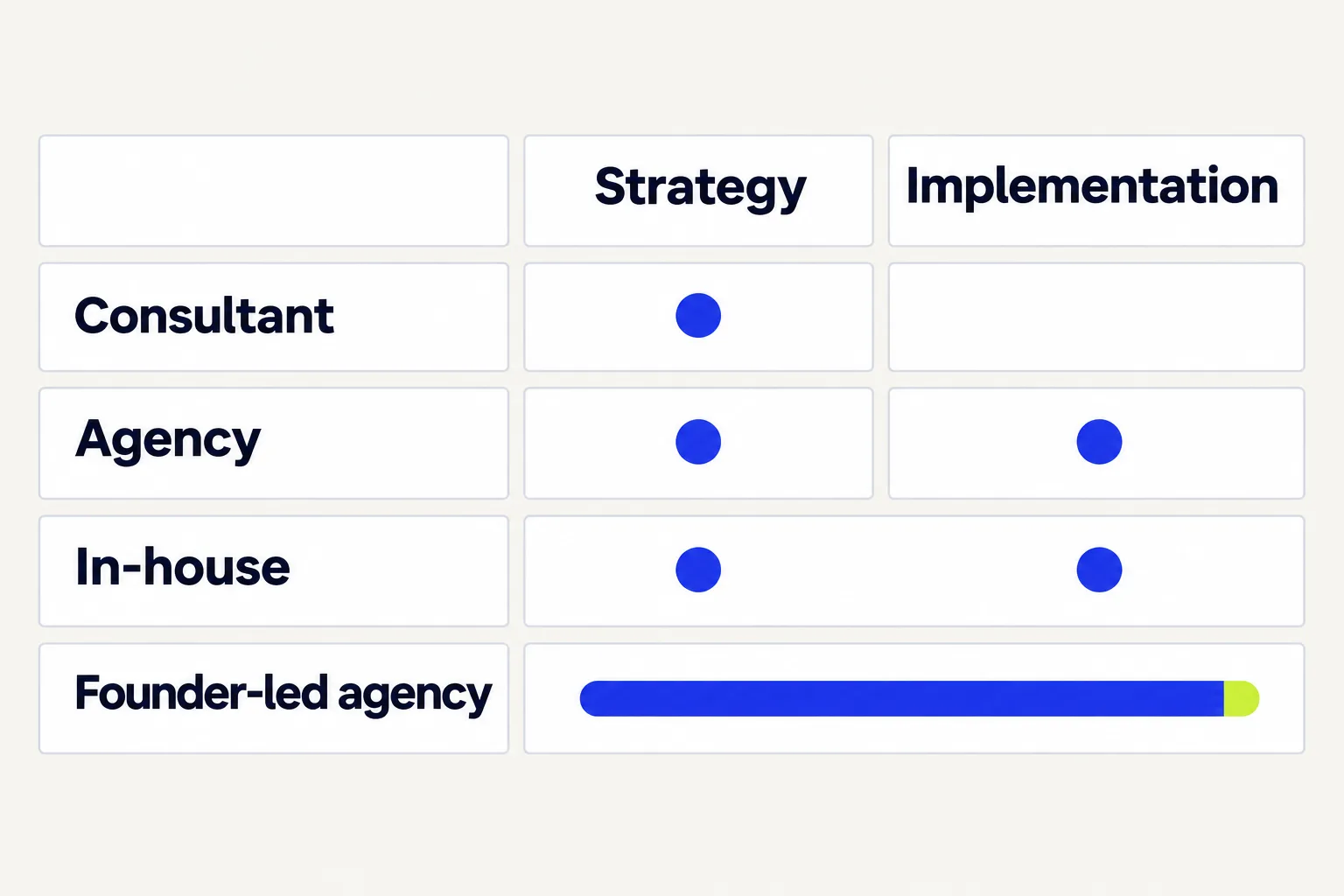
| Model | Strategy | Implementation | Where the gap sits |
|---|---|---|---|
| Consultant | Consultant | Your team | Between the plan and your team's calendar |
| Agency (large) | Strategist or account lead | Delivery staff | Between the strategist and the people doing the work |
| In-house | Your hire | Your hire and other teams | Between one person's skills and the full workload |
| Founder-led agency | Senior person | Same senior person | Capacity: one person's hours |
Read the last column. Each model has a gap, and your job is to pick the gap you can manage. If your team has spare hours and a developer who ships weekly, the consultant gap is small. If your team is full, it is wide, and a plan will sit unused.
How cost works in each model
Cost comparisons mislead because the fees cover different things. A consultant's monthly fee may buy ten hours of advice. An agency retainer may buy a team's time, including content and links. A salary buys a person, and the tools, hiring and management come on top.
For a rough guide, Ahrefs polled 439 SEO service providers. Respondents reported average monthly retainers of $3,209 for agencies, $3,250 for consultants and about $1,349 for freelancers, and average hourly rates of $98.90 for agencies, $71.59 for freelancers and $171.18 for consultants. The same article says 78.2% of the providers surveyed charge a monthly retainer. These are provider-reported averages from a general SEO survey, not B2B prices, and the retainers do not buy the same scope. A $3,000 consultant retainer and a $3,000 agency retainer are different amounts of work. Treat the numbers as context, not a quote.
Ask these questions to compare offers fairly:
- How many hours of senior time do I get each month?
- Who writes, edits and publishes the pages?
- Who fixes technical problems on my site, and how fast?
- What does the fee not cover?
- What is the notice period?
For ranges, packages and what drives them, see B2B SEO pricing.
A capacity test before you choose
Answer these honestly. They matter more than any pros and cons list.
- Who will write and publish the pages? If the answer is "someone, eventually", a consultant's plan will not move.
- Who can change the site? Title tags, internal links, redirects and page templates need a developer or a CMS owner with time.
- Who will give a writer access to an engineer or product expert each week? B2B pages that sell complex products fail without it, whoever writes them.
- Who will own the results? Someone must read the reports, join a monthly call and decide.
- Can you wait six to twelve months for a hire to pay off? If not, an in-house search is the slowest route.
If you answered yes to the first four, a consultant can work well. If you answered no to the first two, you need implementation capacity: an agency or a hire. If you answered no to the third, fix that before spending on anything, because every model stalls on it.
What B2B changes
B2B search differs from consumer search in ways that affect this choice:
- Long buying cycles. A buyer may research for months and involve several people. Pages must serve different roles, from the person who first meets the problem to the one who signs.
- Few, valuable leads. A small number of visits can matter. Traffic reports tell you less than which pages produce sales conversations.
- Product knowledge. Prospects read technical detail. Content written without access to experts reads as generic.
- AI search. Buyers also ask AI tools for shortlists and explanations, so entity clarity and third-party mentions matter alongside rankings. That adds work for whichever model you pick. See AI search for B2B for the detail.
Ask any provider how they get product knowledge out of your sales and engineering teams. The answer separates serious offers from template work.
How each model fails
Every model has a typical failure. Knowing it helps you set up against it.
- Consultant: the plan that sits. A strong audit lands in a shared folder, and nobody has time to act. Fix: agree in advance who owns each task and book the consultant for a review at fixed intervals. Also watch for key-person risk. If the consultant is ill or leaves, you have no continuity.
- Agency: the handoff. The person who sold you the plan is not the person doing the work, and context is lost between them. Fix: ask who will do the work, meet them and check how a brief travels from strategy to delivery.
- In-house: the single point of failure. One person leaves, and the program stops. One person also cannot be an expert in everything. Fix: document the work, budget for outside help on the gaps and keep a second person familiar with the program.
- All models: no site access. If changes need a three-month development queue, no SEO model works. Raise this before signing.
Combining models
You do not have to pick one. Common mixes:
- In-house lead plus consultant. Your hire runs the work and the consultant reviews strategy and trains the hire.
- In-house lead plus agency. The hire sets direction and holds product knowledge, and the agency carries out content, technical or link work.
- Consultant first, then agency or hire. The consultant audits and scopes the program, and you then decide who runs it.
The risk in any mix is unclear ownership. Write down who decides, who builds and who reports before the work starts. Your choice is also not permanent. Many companies start with one model and move to another when their needs change.
The middle path: a founder-led agency
There is a fourth option between a lone consultant and a larger agency. In a founder-led agency, the senior person who plans the work also does it. You get the judgment of a consultant and the implementation of an agency, with fewer handoffs.
Stijg Media works this way. Its site says clients "work directly with the person doing the thinking", with no account managers or junior teams in between, and that it handles strategy and implementation in-house instead of delivering a strategy deck for your marketing team to carry out. Adriaan van Swieten, the founder, has about eight years of SEO experience according to stijgmedia.com. Engagements run month to month with no long-term contract, and scope is set for each project rather than from a fixed package. Stijg Media says it works with established B2B companies, and that it is a poor fit for businesses still finding product-market fit or wanting only high-volume content. It does not guarantee rankings or AI recommendations. Details are on its B2B SEO agency page.
The model has limits. One senior person has a fixed number of hours, so very large content programs or fast, many-site rollouts suit a larger team better. If this fits your situation, you can ask Stijg Media for a plan.
How to decide
| If this describes you | Lean toward |
|---|---|
| You have a team that ships, but nobody who knows what to prioritize | Consultant |
| You need a second opinion on a plan or a hire | Consultant |
| You have no spare hours or no technical, writing or link skills | Agency |
| You want one senior person to plan and do the work | Founder-led agency |
| Your product is complex and SEO needs daily contact with other teams | In-house, with outside help for gaps |
| You need results soon and have no hire in place | Agency or consultant, not a new hire |
| You are unsure | Start with a short consultant or audit engagement, then decide who runs the program |
Two final checks. First, ask each provider for a plan for your first 90 days and compare how specific they are. Second, check that you can reach the person who will do the work. Once you know the model, use the guide to choosing a provider to compare candidates.
Frequently asked questions
What is the difference between a B2B SEO consultant and an agency?
A consultant sells expert judgment: audits, strategy and reviews, usually from one person with limited hours. An agency sells a team that plans and carries out the work, including content, technical fixes and links. With a consultant, your own staff usually implement the plan. With an agency, the agency does most of the implementation for a monthly fee.
Is a B2B SEO consultant cheaper than an agency?
Not always. In an Ahrefs survey of 439 SEO providers, reported average retainers were $3,209 for agencies and $3,250 for consultants, with freelancers lower. The fees buy different things, so compare scope, not price. A consultant fee often excludes the writing, development and link work you then pay for in staff time.
When should a B2B company hire in-house instead?
Hire in-house when SEO needs daily contact with product, sales and engineering, and you can afford a search and ramp-up period. A single hire covers one person's skills, so plan for outside help on gaps such as technical SEO or link building. If you need results within months, an in-house search is the slowest route.
Can I use a consultant and an agency together?
Yes, if ownership is clear. A consultant can review an agency's plan, set priorities or train an in-house lead while the agency carries out the work. Write down who decides, who builds and who reports before starting. Without that, the two parties duplicate work or leave tasks undone.
What is a B2B SEO freelancer, and how is it different from a consultant?
The terms overlap. A freelancer usually sells hands-on work such as writing or technical fixes on an hourly, project or retainer basis. A consultant usually sells direction and review. Many people do both. Ask what the engagement includes, who does the implementation and what happens if the person is unavailable.
What is the safest way to start if I am unsure which model fits?
Start with a short, bounded engagement, such as an audit or a 90-day plan, and judge the output. Check how specific the priorities are and whether someone can carry them out. Then decide whether a consultant, an agency or a hire should run the program.