
- Start from your own sales process and a business goal, not from an agency's service list.
- Shortlist three to five agencies, then ask each one the same questions and compare the answers side by side.
- Ask every agency how it connects search work to leads, opportunities and revenue. Rankings alone do not answer that.
- Walk away from anyone who guarantees a ranking. Google says no one can.
- Read the proposal and contract before you sign: who does the work, who owns the accounts, how you can leave.
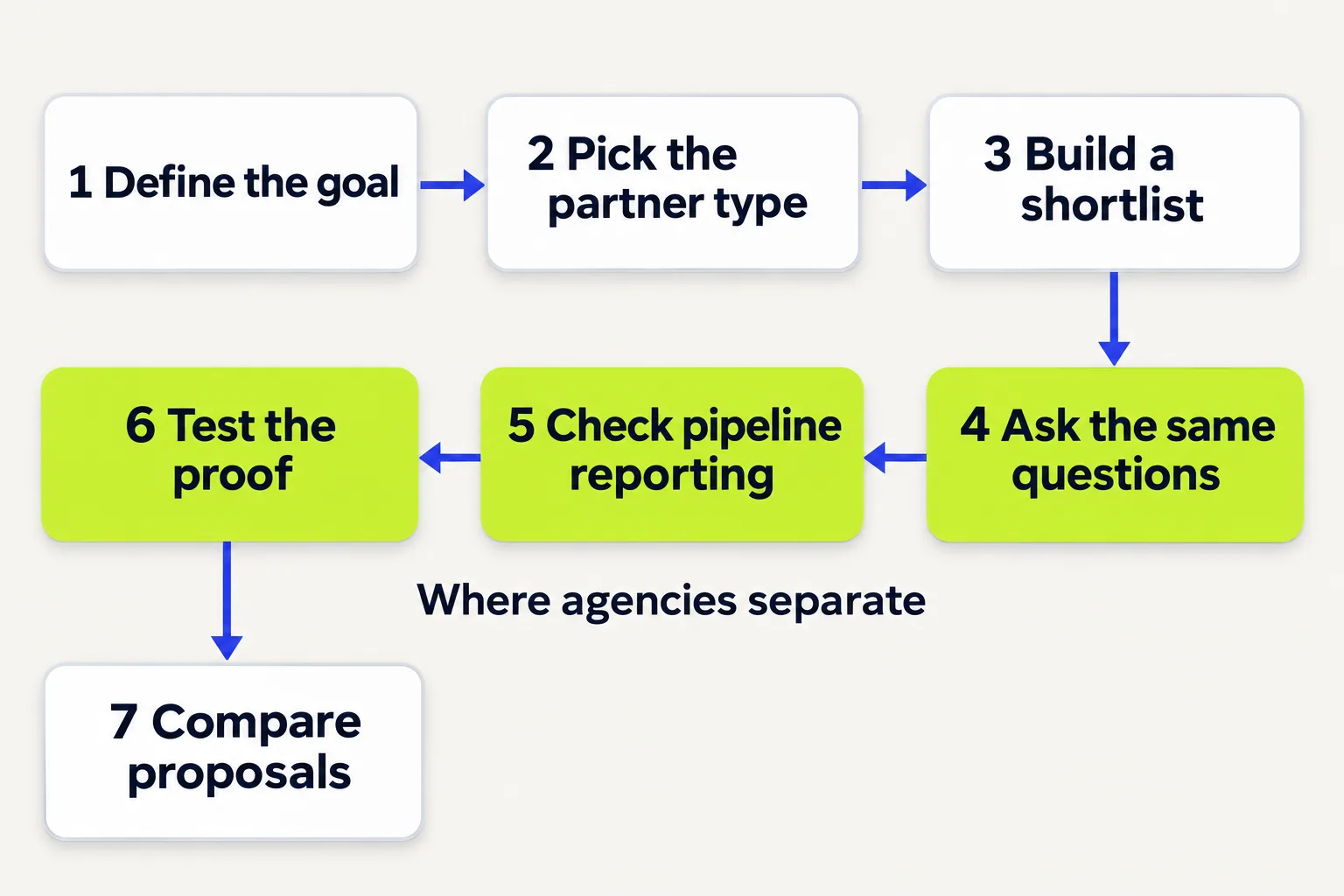
To choose a B2B SEO agency, work through seven steps. Define the business goal. Decide what type of partner you need. Build a short list. Ask every agency the same questions. Check how each one reports pipeline. Test their proof. Compare the proposals and contract terms. This page walks through each step with the questions to ask, what a strong answer sounds like and what a weak one sounds like.
The short answer: seven steps
- Define the goal. Write down the revenue outcome, the buyers you want and your sales cycle.
- Pick the type of partner. Specialist agency, full-service agency, consultant or in-house hire.
- Build a shortlist. Three to five candidates, found through referrals, searches and communities, not only ads.
- Ask the same questions. Use one list for every call so you can compare answers.
- Check pipeline reporting. See a real report and ask how it ties to your CRM.
- Test the proof. Case studies, references and a sample of the work.
- Compare proposals and contracts. Scope, staffing, access, notice period.
Step 1: Start from your sales process and goal
Before you talk to any agency, write down how your company wins customers. Most agency guides start with the agency's skills. A better starting point is your own buying process, because the right SEO plan follows it.
Answer these questions in a page or less:
- Who buys from you? List the roles: the user, the economic buyer, the technical reviewer, procurement.
- How long does a typical deal take, from first visit to signed contract?
- Which pages or search topics do those buyers use at each stage: problem research, vendor comparison, final check?
- What counts as a win: a demo request, a qualified lead, a sales opportunity, closed revenue?
- Which systems hold the data: CRM, marketing automation, analytics?
B2B buying involves several people and often a long cycle, so a traffic target alone is a weak goal. A goal such as "more qualified demo requests from buyers searching for our category" gives an agency something to plan against and gives you something to judge them on. It also lets you spot agencies that never ask about any of this. If a first call finishes without a single question about what you sell, who buys it and how deals close, treat that as information.
Also decide what you can do in-house. Some teams have writers or developers and need strategy and technical direction. Others need the agency to implement everything. The answer changes the type of partner you need and the price you will be quoted. For how pricing varies, see our B2B SEO pricing guide.
Step 2: Pick the type of partner
Match the partner type to your gap. The same budget buys different things from different kinds of provider.
| Option | Fits when | Watch for |
|---|---|---|
| B2B SEO specialist agency | You need strategy and delivery for long sales cycles, and no in-house SEO team. | Narrow niche claims you cannot check. Ask for the work, not the label. |
| Full-service marketing agency | You want SEO, paid, web and email under one roof. | SEO as one of many lines, junior staff on the account. |
| Independent consultant | You have a team that can implement and need direction and review. | Capacity if you also need content and development. |
| In-house hire | SEO is a permanent, high-volume need and you can manage the person. | One person rarely covers technical, content and links alone. |
If you are weighing an agency against a consultant, read B2B SEO consultant or agency before you build the shortlist. If you are still unsure what you would be buying, the B2B SEO services page explains what the work includes.
Step 3: Build a shortlist of three to five
Keep the list short enough to compare properly. Three to five agencies gives you contrast without turning the process into a second job.
Sources worth using:
- Referrals from peers at B2B companies of a similar size and sales cycle.
- Searches for your own category terms, to see who writes useful material about problems like yours.
- Industry communities and events where practitioners share work openly.
- "Best agency" lists and directories, used only as a starting point. Many are written or paid for by the agencies listed, so check how a list was made before you trust its order.
Look at each agency's own website before any call. A B2B SEO agency should be able to make its own pages clear, fast and easy to find. This proves little on its own, but a site that is vague about who the agency serves and what it does is a poor sign.
Step 4: Ask every agency the same questions
Use one list for every call and write the answers down. Comparing recalled impressions favors the best presenter. Comparing written answers favors the best fit. The table below gives each question, what a strong answer sounds like and what a weak one sounds like.
| Question | Strong answer | Weak answer |
|---|---|---|
| How do you define success for a company like ours? | Names an outcome tied to your goal (qualified leads, opportunities) and agrees how to measure it before work starts. | Talks about rankings, traffic or "visibility" only. |
| What do you need to know about our buyers before you plan? | Asks about roles, sales cycle, deal size, current lead sources and sales objections. | Starts listing keywords or tasks without questions. |
| Who will work on our account, and who does the work? | Names people and roles. Explains who does strategy and who does hands-on work. | Senior people in the pitch, unnamed staff after signing. |
| Show me a recent B2B engagement, from baseline to result. | States the starting point, the work done, the period, how the result was measured and what is still uncertain. | Only a headline percentage with no baseline or time frame. |
| How do you handle link building? | Describes earned and editorial methods in plain terms. Says they do not buy links for ranking. | Vague talk of "outreach at scale", hidden lists, no examples. |
| What would you do in the first 90 days? | A sequenced plan: baseline, priorities, fixes, content, measurement. Admits what depends on what they find. | The same package for every client. |
| What results do you expect and in what time frame? | Gives a reasoned range with conditions, says SEO takes months, and refuses to guarantee. | A fixed date or ranking promise. |
| How do you handle AI search such as ChatGPT or AI Overviews? | Explains what they track and test, and says results are not guaranteed. | Promises of AI recommendations, or "AI optimization" with no method. |
| What access and ownership do we get? | You own the analytics, Search Console, content and accounts from day one. | They hold the accounts or report from their own tools only. |
| What happens if the work is not going well? | Clear review points and a notice period you can live with. | Long lock-in with no review. |
Google makes a related point in its own guidance on hiring an SEO. It suggests asking a prospective provider what results they expect and in what time frame, and it notes that "you are responsible for the actions of any companies you hire" (Google Search Central). That second line is a reason to ask about methods, not only outcomes.
Step 5: Check how they report pipeline
Ask to see a real report, with client details removed, before you sign. Reporting is where B2B SEO work either connects to revenue or stops at traffic.
A report worth paying for usually shows several layers:
- Search performance: impressions, clicks and rankings for the terms your buyers use.
- Site behavior: visits to the pages that matter, and what visitors did next.
- Leads: form fills, demo requests and calls from organic search.
- Pipeline: opportunities and revenue, where your CRM can be matched to the source.
- Work done and next priorities, so you can see what was delivered for the fee.
Ask how they handle the hard parts. B2B attribution is imperfect. Buyers research for weeks, several people from one company visit, and some of the influence of search never shows as a click. A good agency says this openly and explains how it deals with it, for example by checking the lead source field in your CRM and asking new leads how they found you. A weak one hands you a chart of ranking positions and calls it success.
Ask also about timing. Early reports should show progress on leading signals such as pages fixed, topics covered and visibility growth, and should not claim revenue in month one. Revenue comes later in a long-cycle business.
Step 6: Test the proof
Treat a case study as a claim to check, not a fact. Four questions help:
- What was the baseline, and over what period did the change happen?
- Was the result measured in leads or revenue, or only in traffic and rankings?
- What else changed in that period: a redesign, paid spend, a new product, a brand campaign?
- Is the client in B2B, with a sales cycle like yours?
Then ask for a reference you can call. A client who agrees to speak with you is stronger evidence than any page on the agency's site. Ask the reference what the agency did, how often they communicated and what they would change.
What if the agency has few B2B case studies?
Smaller and newer agencies often cannot show named B2B results, because clients limit what can be published. That is not an automatic disqualifier, but it moves the burden to other tests. Ask for a sample of working documents with names removed, such as a keyword and topic plan, a content brief or a monthly report. Ask for a short analysis of your own site before you commit, and judge its specifics. A real finding about your pages tells you more than a polished deck. Ask what the agency will advise you not to do. An agency that says "SEO may not pay back for you yet" in the right situation is easier to trust than one that says yes to everyone.
Red flags to watch for
The clearest red flag is a guarantee. Google's guidance says: "No one can guarantee a #1 ranking on Google." It adds: "If they guarantee you that their changes will give you first place in search results, find someone else" (Google Search Central).
Other warning signs:
- Guaranteed rankings, traffic or AI recommendations. No honest provider controls these.
- A fixed ranking timeline. Promises such as "page one in 60 days" ignore your competition and your site's starting point.
- Paid links for ranking. Google's spam policies list exchanging money for links as link spam (Google Search Central). A penalty can cost you far more than the fee.
- Rankings-only reporting. No leads, no pipeline, no discussion of what the numbers mean for revenue.
- Keyword targeting by search volume alone. In B2B, a term with 50 monthly searches can be worth more than one with 5,000 if the searchers are buyers.
- No questions about your business. A proposal that arrives before a real conversation about your buyers.
- Senior pitch, junior delivery. You meet the principal, then never see them again.
- Refusing to share access. You should own your analytics and Search Console from the start.
- A sample audit only after signing. Some analysis before you sign is a fair test of fit.
- Secret methods. "Proprietary process" with nothing you can explain to your own leadership.
Score the agencies
Score each shortlisted agency from 1 to 5 on the same criteria. Do it after the calls, from your written notes. Adjust the weights to your situation, and add them up only as a guide, not a verdict.
| Criterion | Evidence to look for | Score (1 to 5) |
|---|---|---|
| Understands your buyers | Asked about roles, sales cycle, deal size and objections before proposing anything. | Yours |
| B2B experience | Work for companies with long cycles. Examples or references you can check. | Yours |
| Measurement | Shows a report that reaches leads and pipeline, and explains attribution limits. | Yours |
| Method | Explains technical, content and link work in plain terms. No paid links. | Yours |
| Team and access | Named people. You own the accounts. Clear who does what. | Yours |
| Honesty | No guarantees. Says what depends on your site and market. Willing to say no. | Yours |
| Commercial terms | Scope is clear, the notice period is fair and the price matches the scope. | Yours |
| Communication | Clear cadence, fast answers on the calls, agrees on how you will review progress. | Yours |
Honesty and measurement should weigh more than polish. A confident pitch with a guarantee should lose to a modest one with a clear plan.
Compare proposals and check the contract
Compare proposals on scope, not on the monthly figure alone. Two quotes of the same size can cover very different amounts of work. Lay them next to each other and check:
- What exactly is delivered each month, and what is only "supported"?
- How many hours or how much senior time does the fee buy?
- Does the quote cover content and development, or only advice?
- Which tools and subscriptions are included, and who pays for them?
- What is the first 90 days plan, and what gets measured at the end of it?
Cost varies widely with scope, competition and how much work your team does itself. Published ranges are rarely like-for-like, so use them only as context. Our pricing guide covers the ranges and what drives them.
Then read the contract with these points in mind:
- Term and notice. A month-to-month term or a short notice period lowers your risk. A long lock-in with no performance review raises it.
- Ownership. You should own your content, your analytics and your accounts, and keep access if you leave.
- Staffing. The people named in the pitch should be named in the agreement.
- Scope changes. How are extra requests priced?
- Methods. A clause that the agency will follow Google's spam policies is reasonable, and so is a right to review any outside links or content placed for you.
- Reporting. The format and cadence are written down.
What the first 90 days should show
After signing, you should see a baseline, a priority plan and the first fixes within the first quarter. You should not expect a full revenue result in that time, and you should be wary of anyone who promises one.
A reasonable first quarter includes:
- A baseline of current rankings, traffic, leads and, if relevant, AI search visibility for a fixed set of buyer questions.
- A ranked list of opportunities, tied to the pages and topics most likely to influence pipeline.
- Fixes to the site's technical problems and to your most important commercial pages.
- The first new or improved content, planned against buyer questions.
- A first report that shows what was done, what changed and what comes next.
Use this as a checkpoint. If, by the end of month three, you cannot say what has been done and why, raise it in writing. If you plan a trial, agree in advance what you will judge it on.
How Stijg Media handles this
Stijg Media is the agency behind this site, so weigh this section as one party's description. Stijg Media is founder-led. Adriaan van Swieten works directly with each client, with no account managers or junior handoffs, and the agency handles both strategy and implementation for established B2B companies. It does not guarantee rankings or AI recommendations, and it states that attribution is imperfect when it connects search results to leads and revenue. Engagements are month-to-month with no long-term contract, and scope is custom, quoted after a free analysis with no obligation. If you want to see how those answers line up with the questions above, you can ask for the analysis and judge it against your own list. For the full service description, see our B2B SEO agency page.
Common mistakes when hiring
- Choosing on price alone. The cheapest quote often buys the least thinking. The most expensive does not guarantee more.
- Skipping the goal. Without a written goal, any result can be called a success.
- Judging by the pitch. Presentation skill is not delivery skill. Use the same questions and the scorecard.
- Expecting fast revenue. SEO typically takes months to compound. Agree on leading signals for the early period and on revenue signals for later.
- Giving up access. Keep ownership of analytics, Search Console, hosting and content.
- Skipping a sample of the work. A short analysis or a plan for your site tells you more than references alone.
- Hiring before you know the problem. If you are unsure what is wrong with your site's search performance, a B2B SEO audit is a bounded first step that also shows how an agency thinks.
Frequently asked questions
How do I choose a B2B SEO agency?
Define your business goal first, then decide what type of partner you need, build a shortlist of three to five, and ask every agency the same questions. Check how each reports leads and pipeline, test their proof with references and a sample of the work, and compare proposals and contract terms before you sign. Score each agency on the same criteria.
What questions should I ask a B2B SEO agency?
Ask how they define success, what they need to know about your buyers, who will do the work, how they handle link building, what the first 90 days look like, what results they expect and in what time frame, and what access you will own. Ask to see a recent engagement from baseline to result, with the measurement method explained.
What are the biggest red flags when hiring a B2B SEO agency?
A guarantee of rankings is the clearest. Google says no one can guarantee a number one ranking. Other warning signs are paid links, reporting that stops at rankings, no questions about your buyers, senior staff in the pitch and junior staff after signing, refusing to give you access to your analytics, and secret methods.
How long does it take to see results from a B2B SEO agency?
It varies with your site, your competition and the work needed, so be wary of any fixed date. SEO usually takes months, and revenue results arrive later than traffic in a long sales cycle. Ask the agency what it expects and why, and agree on early signals such as fixes shipped and visibility, then leads and pipeline later.
Should I choose a B2B specialist or a full-service agency?
Choose by the gap you need filled. A specialist usually fits long sales cycles and multiple buyers, and a full-service agency can fit if you want several channels under one roof. Either way, ask who works on your account and for evidence of similar B2B work, because a label tells you little about delivery.