
B2B SEO is the work of making your company findable in search for the questions business buyers ask before they buy. A B2B SEO strategy is the plan that decides which of those questions to answer first, with which pages, and how you will prove the work produced pipeline instead of traffic. This guide gives you that plan in eight steps, in the order we would do them.
- B2B SEO targets a buying group, not one person, so each important page has to answer a specific role's question.
- Search volume is lower and intent is higher. A term with 20 searches a month can be worth more than one with 2,000.
- Start with pages that sit next to the buying decision: alternatives, comparisons, use cases, pricing context. Build education content after.
- Measure qualified leads and pipeline. Rankings and sessions are inputs, not results.
- Expect months, not weeks. Anyone who guarantees rankings is selling something else.
Some companies run this plan in house. Others bring in a B2B SEO agency to carry the strategy and the implementation. Stijg Media is one such option, and the section near the end explains how it works. The steps below apply either way.
What is B2B SEO?
B2B SEO is search engine optimization for companies that sell to other organizations. It improves how your site and content rank, and how AI answers describe you, for the searches that business buyers run while they research a problem, compare vendors and justify a purchase.
HubSpot defines it in similar terms: optimizing a company's website and content to rank in search results for the terms business buyers use, with the goal of reaching the decision-makers who influence a purchase. The wording matters because it shifts the goal. You are not trying to attract the most visitors. You are trying to be present, credible and clear when the right people search.
Two things set the practice apart. The buyer is a group of people with different jobs and worries, and the sale takes a long time. Everything else in a B2B SEO strategy follows from those two facts.
How B2B SEO differs from B2C SEO
B2B and B2C SEO use the same search engines and the same fundamentals. Ahrefs makes this point in its own guide: the process is essentially the same, and the audience is what differs. The differences that change decisions are these.
| Factor | B2B SEO | B2C SEO |
|---|---|---|
| Who decides | A group: an owner of the problem, a budget holder, technical and legal reviewers | Usually one person or a household |
| Sales cycle | Weeks to months, with repeated research | Minutes to days |
| Search volume | Low per term; many narrow terms | High per term; fewer broad terms |
| Best-fit content | Comparisons, use cases, technical detail, proof, integration and security answers | Product pages, reviews, buying guides |
| Conversion | Demo, quote, call, consultation | Purchase or sign-up |
| Success measure | Qualified leads, opportunities, pipeline | Orders and revenue |
MarTech's guide lists decision timeline, stakeholder involvement, content, risk tolerance, search behavior and conversions among the differences, and it cites a four to six month journey from identifying a problem to a sales call. Treat that range as one published figure, not a rule. Your own sales cycle is the number that matters.
Where to start: the order matters more than the list
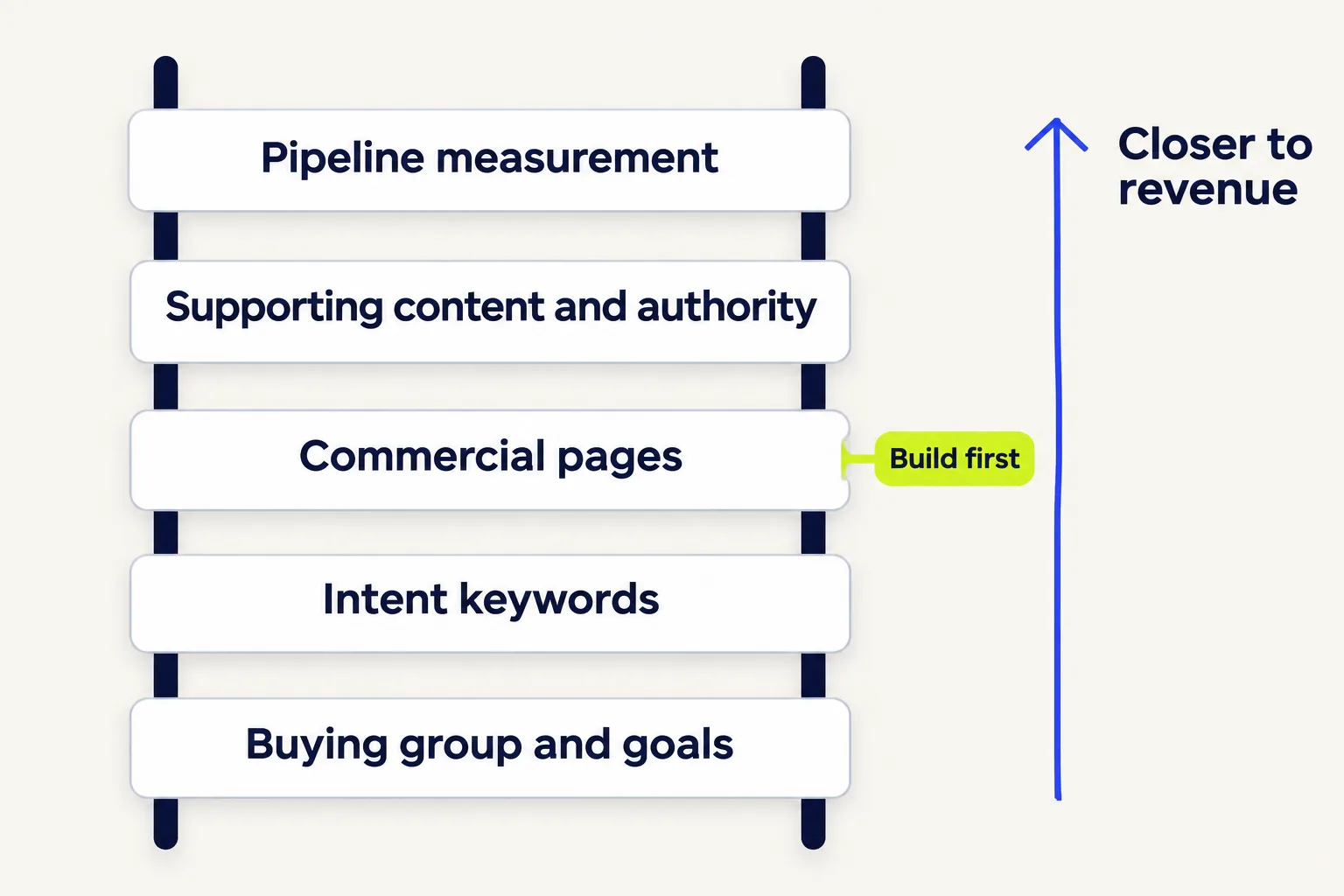
Most guides give you seven to nine steps with equal weight. A small team cannot do nine things at once, so use this order. Pages close to the purchase come first because they convert the traffic you already have and the traffic you win soonest. Education content comes later because it builds slowly.
- Set goals tied to pipeline and name the buying group.
- Research keywords by intent, not by volume.
- Build or fix the bottom-of-funnel pages.
- Add supporting content for the rest of the journey.
- Fix the technical issues that block crawling and indexing.
- Earn authority from sources your buyers trust.
- Make the site easy for AI answers to retrieve and cite.
- Measure by pipeline and adjust every quarter.
If you have limited time, do steps 1 to 3 and the technical fixes in step 5 first. Together they put the right pages in front of the right searchers on a site that search engines can read.
Step 1: Set pipeline goals and map the buying group
Write the goal as a business result
Start with the result the business needs: qualified demo requests, sales conversations or quote requests from organic search. Then work backwards. If your sales team closes one in five qualified opportunities and each deal is worth a known amount, you can estimate how many organic leads you need. This keeps the strategy honest when traffic charts look good and the pipeline stays flat.
Define the ideal customer
List the industries, company sizes, tools they already use, and problems that make a company a good fit. Include the ones you want to avoid. A clear ideal customer profile tells you which searches to chase and which to ignore.
Map the roles in the buying group
A B2B purchase usually involves several people. Each asks a different question, and each question is a search. The table shows a common pattern. Replace the roles with the ones in your own deals.
| Role | Typical question | Page that answers it |
|---|---|---|
| Problem owner (manager, lead) | How do we fix this, and what are our options? | Solution and use-case pages, comparison guides |
| Budget holder (executive, finance) | What does it cost, and what return can we expect? | Pricing context, ROI explainer, case evidence |
| Technical reviewer (IT, security, engineering) | Does it integrate, and is it secure? | Integration, security and technical documentation pages |
| Procurement and legal | What are the terms, and who else uses it? | Terms, compliance, customer proof |
Ask your sales team for the last ten lost and won deals. The questions prospects raised on calls are your first keyword list, and they cost nothing to collect.
Step 2: Research keywords by buyer intent
In B2B, intent beats volume. Group searches by what the person is trying to do.
- Problem-aware: "how to reduce [problem]", "why does [problem] happen". These bring early research and low immediate demand.
- Solution-aware: "[category] software", "[service] for [industry]". These bring people comparing approaches.
- Vendor-aware: "[your brand] alternatives", "[category] pricing", "[tool] vs [tool]", "[service] provider". These bring people close to a decision.
Low volume is normal and often good. A search that 30 people make each month, all of them in your target accounts, can matter more than one that 3,000 people make with no buying intent. Do not drop a term because a tool shows a small number. Ask who types it and what they do next.
Collect real buyer language from four places: sales calls and emails, support tickets, the questions competitors' pages answer, and your own search console data. Then cluster terms by the problem they describe, not by shared words. One page should answer one cluster.
Step 3: Build the pages closest to the sale first
These pages carry the most weight per visit. Build or rewrite them before you publish another blog post.
- Service or product pages for each distinct offer, written for a named buyer and a named problem.
- Industry or use-case pages that speak to one sector's rules, tools and risks.
- Comparison and alternatives pages that treat the choice fairly, including when a competitor fits better.
- Pricing context pages that explain what drives cost, even if you do not publish a price list.
- Integration, security and compliance pages that answer the technical reviewer.
- Proof pages such as case studies, customer stories and named results, when you have real ones.
Each page needs a plain answer in the first lines, evidence a skeptical reader can check, and one clear next step. Do not fill these pages with general education. A buyer who arrives from a vendor search wants specifics: what you do, who it is for, how it works, what it costs to start, and what to expect.
If this describes a gap on your site, an audit shows where the gaps are. Our guide to a B2B SEO audit covers what to check and how to rank the findings.
Step 4: Add content for the rest of the journey
Once the commercial pages exist, support them. Educational content earns its place in B2B when it does one of three jobs: it answers a question earlier in the buying journey, it builds trust with a specific role, or it earns links and mentions from sources buyers read.
- Build clusters around your main problems. One hub page covers the topic, and narrower pages cover the questions inside it. Link them to each other and to the relevant commercial page.
- Write for the expert, not the beginner, unless the beginner is your buyer. B2B readers punish thin advice quickly.
- Add original material where you can: your own data, process notes, templates, benchmarks drawn from real work. Content that repeats the top ten results gives a searcher no reason to choose it.
- Match format to intent. Comparisons use tables. Processes use numbered steps. Definitions get a direct first sentence.
Publish fewer pieces and finish them. Ten well-built pages that answer real questions beat fifty generic posts.
Step 5: Fix technical issues that block the pages
Technical SEO keeps good pages from being ignored. For most B2B sites, the checklist is short.
- Pages you want to rank are crawlable, indexable and return a normal status code.
- One canonical URL per page, with no duplicate versions competing.
- Clean site structure: commercial pages sit within a few clicks of the home page and receive internal links from related content.
- Fast, stable pages on mobile and desktop.
- Important content is present in the HTML that loads, not hidden behind scripts that a crawler may skip.
- Titles, headings and structured data describe what the page actually is.
Large B2B sites add migrations, faceted navigation, documentation subdomains and international versions to the list. Those need specific checks and are better handled in an audit than in a general strategy.
Step 6: Earn authority from sources your buyers trust
Search engines and AI answers weigh who else vouches for you. In B2B, a few relevant mentions beat many irrelevant ones.
- Trade and industry publications that your buyers read.
- Partners and integration listings that link to you because the relationship is real.
- Original research and tools that others cite because it is useful.
- Speaking, podcasts and expert commentary that earn mentions from event and media sites.
- Customer and association pages that list you where your category is listed.
Avoid bought links from irrelevant sites, and do not trade quality for count. A link from a publication your buyers actually read does two jobs: it supports rankings and it puts your name in front of the right people.
Step 7: Make the site easy for AI answers to use
B2B buyers now ask AI assistants for vendor shortlists and explanations, and search results often show an AI summary above the links. That changes how you are found, but it does not replace the fundamentals. The pages that get cited tend to be clear, specific, well supported and easy to retrieve.
In practice: state the answer directly near the top of each page, name your company, product and category consistently, keep key facts in plain HTML, and earn mentions on third-party sites. HubSpot's guide also covers answer engine optimization as part of a B2B plan. The topic is large enough to treat separately, and our guide to AI search for B2B goes into what to do and how to track it.
Step 8: Measure by pipeline, not traffic
Measure in layers, and judge the strategy by the top layer.
| Layer | What to track | What it tells you |
|---|---|---|
| Outcomes | Pipeline and revenue from organic, closed-won deals with an organic touch | Whether the strategy pays |
| Leads | Qualified demo, quote and contact requests from organic search | Whether the right people convert |
| Engagement | Conversion rate and visits on commercial pages | Whether pages persuade |
| Visibility | Rankings for target terms, impressions, AI citations and mentions | Whether you are being found |
| Health | Indexed pages, crawl errors, page speed | Whether anything blocks progress |
Track the form field "how did you hear about us" next to your analytics. B2B buyers often research privately for weeks, then arrive by direct visit or a branded search, so analytics alone undercounts search. Ask new leads and ask the sales team. Where your CRM allows it, connect organic sessions to leads and opportunities.
Low volume makes weekly charts noisy. Review quarterly, compare against the same period a year earlier, and decide what to scale, fix or drop.
How long does a B2B SEO strategy take to work?
Expect the first signs in months and a compounding effect over a year or more. The timing depends on your starting point: the state of your site, how competitive your terms are, how much you can change quickly, and how long your sales cycle runs. A site with indexing problems and no commercial pages starts from further back than one with solid pages and a small gap.
Fixes to technical blockers and rewrites of existing commercial pages tend to show first. New content and authority take longer. Then your sales cycle adds its own delay between a lead appearing and revenue closing. Plan on a quarterly rhythm, and be wary of anyone who promises a ranking date. Search engines do not offer guarantees, and neither should an agency or a consultant.
An illustrative example of the ordering
Take a fictional company that sells scheduling software to dental groups. The example is invented to show the logic and does not describe a real client or result.
- A search such as "dental group scheduling software" is narrow, and a keyword tool may show a few dozen searches a month. Everyone who types it is a likely buyer, so a strong page for it comes first.
- "Dental scheduling software integration with practice management" matches the technical reviewer's question. A page that answers it removes a common reason for a stalled deal.
- "How to reduce no-shows" has far more volume. The readers include practice managers, front-desk staff and students. A guide on it is useful later, as a supporting page that links to the commercial page.
The commercial pages bring fewer visits and more demo requests. The guide brings more visits and fewer demo requests. If you build the guide first, the charts look better for six months and the pipeline barely moves.
Who should run the strategy
The strategy needs three skills: search research, writing and publishing, and technical fixes. Companies with a marketing lead and a developer can often cover the first steps in house. Companies without that capacity, or without time, hand some or all of it to an outside team. The deciding question is not who writes the plan. It is who builds the pages, makes the fixes and reports the results. If you are weighing outside help, our guide to how to choose a B2B SEO agency lists the questions to ask.
Common B2B SEO mistakes
- Chasing volume. High-volume terms bring readers who will never buy.
- Writing for one persona. The buyer is a group. The page that works for the manager may fail the technical reviewer.
- Publishing education before commercial pages. Traffic arrives and has nowhere useful to go.
- Treating the blog as the strategy. The blog supports the commercial pages. It does not replace them.
- Reporting traffic. Leadership cares about leads and pipeline.
- Splitting strategy from execution. A plan nobody implements produces nothing. Agree who builds, who approves and by when.
- Copying competitors. Matching what ranks is the starting point. The pages that win add something true and specific that the others lack.
How Stijg Media handles B2B SEO strategy
Stijg Media is a founder-led SEO and AI search agency. Adriaan van Swieten, who has worked in SEO for eight years, leads the work. According to stijgmedia.com, the process maps the Google searches and AI prompts buyers use, builds a priority plan ranked by likely revenue impact, improves the site and search assets directly, builds authority through links and third-party mentions, then measures rankings, traffic, calls and leads to decide what to scale, improve or drop.
The promise is the same one this guide argues for: from search strategy to implementation, without the handoffs. Stijg Media does not hand over a strategy deck and leave. Engagements run month to month with no long-term contract, start with a free visibility analysis, and are quoted after it. Stijg Media does not guarantee rankings or AI recommendations. The B2B SEO services page lists what the work includes. If you want a view of your own starting point, request the free analysis below.
What to do this month
- Write the pipeline goal and list the roles in your buying group.
- Pull the questions from your last ten won and lost deals.
- List your commercial pages and mark the missing ones: use cases, comparisons, integrations, pricing context.
- Check that those pages are indexable and linked from your main navigation.
- Set up lead tracking that separates organic search from other sources, and add the "how did you hear about us" question.
- Decide who will build the pages and by when. For cost questions, see our B2B SEO pricing guide.
A strategy is only useful if it turns into pages, fixes and measurements that someone owns. Start with the pages nearest the sale, and let the data decide what to build next.
Frequently asked questions
What is B2B SEO?
B2B SEO is search engine optimization for companies that sell to other organizations. It aims to make your site and content rank, and be cited by AI answers, for the searches business buyers run while researching a problem, comparing vendors and justifying a purchase. The goal is qualified leads and pipeline, not raw traffic.
How is B2B SEO different from B2C SEO?
The fundamentals are the same. The differences come from the buyer. B2B purchases involve a group of people, take weeks or months, and rely on narrow, low-volume searches with high intent. Content leans toward comparisons, technical answers and proof, and success is measured in leads, opportunities and pipeline rather than orders.
Where should a B2B company start with SEO?
Start with a pipeline goal and a list of the roles in your buying group. Then research keywords by intent and build the pages closest to the sale first: service, industry, comparison and integration pages. Fix technical blockers on those pages. Publish educational content after the commercial pages exist.
How long does B2B SEO take to work?
Expect the first signs in months and compounding results over a year or more. Technical fixes and rewrites of existing commercial pages usually show first. New content and authority take longer, and a long sales cycle adds delay between a lead and revenue. Nobody can honestly guarantee a ranking date.
How do you measure B2B SEO?
Judge it by qualified leads, opportunities and pipeline from organic search. Treat rankings, impressions, traffic and AI citations as inputs that show visibility. Because buyers often research privately and return directly, add a how-did-you-hear-about-us field and connect organic sessions to your CRM where possible. Review quarterly, since low volume makes weekly data noisy.
Does AI search change a B2B SEO strategy?
It adds a layer but does not replace the basics. Buyers now ask AI assistants for explanations and vendor shortlists. Pages that state clear answers, name the company and category consistently, keep key facts in plain HTML and earn third-party mentions are easier to retrieve and cite. Keep building useful commercial pages first.