
B2B SEO services are the set of search work that helps a business-to-business company get found by the people who buy from it, and turns that visibility into qualified leads. A complete scope has six parts: ICP and keyword mapping, technical SEO, bottom-of-funnel content and landing pages, link building and digital PR, AI search work, and pipeline tracking with reporting.
- Six services make up a full B2B SEO scope. Each should produce something you can see and check.
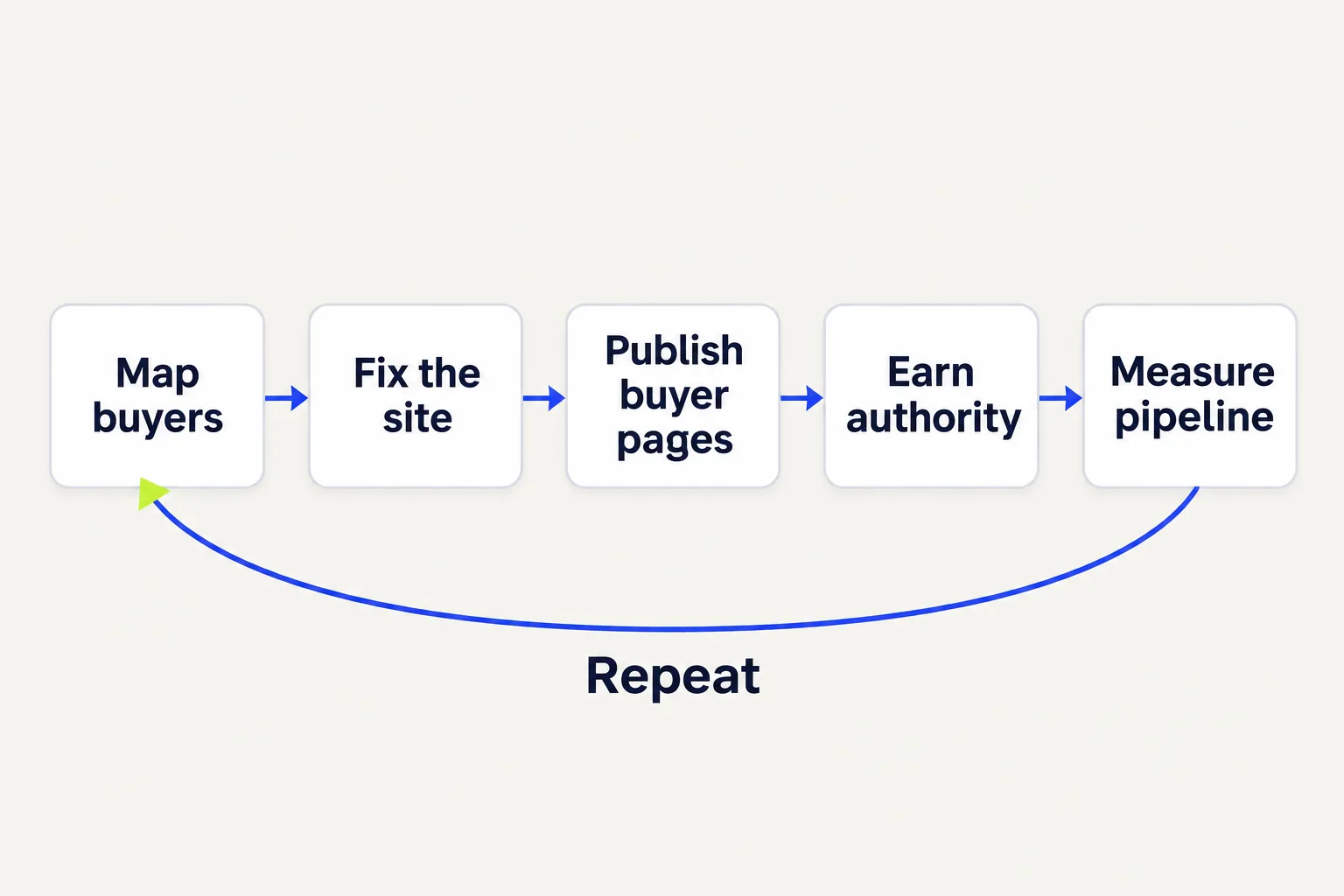
- The work runs in order: map the buyers, fix the site, publish the pages buyers need, earn authority, then measure against pipeline.
- Some work is a project (audit, strategy, migration). Some repeats every month (content, links, reporting).
- Ask who does the work. A plan with no implementation behind it is not a service.
If you are comparing providers rather than scoping the work, start with our overview of the B2B SEO agency options. This page covers what the work itself consists of, so you can judge any proposal against it.
What B2B SEO services include
B2B SEO services include the research, site fixes, content, outside authority and measurement needed for a company to appear when its buyers search. They go from the first query a buyer types to the opportunity logged in your CRM.
The six services are:
- ICP and keyword mapping. Who buys, what they search at each stage, and which queries deserve a page.
- Technical SEO. Crawling, indexing, site architecture, internal links, structured data and speed.
- Bottom-of-funnel content and landing pages. Solution, comparison and industry pages built for buyers who are close to a decision.
- Link building and digital PR. Mentions and links from publications and sites your buyers trust.
- AI search work. Making your pages and brand easy for AI answer engines to find, read and cite.
- Pipeline tracking and reporting. Connecting search traffic to leads, opportunities and revenue.
How B2B SEO services differ from general SEO services
B2B SEO services differ from general SEO services in who they target and how success is judged. The buyer is often a group of people, the sales cycle is long, and a few hundred well-matched visits can matter more than tens of thousands of loosely related ones.
That changes the work in three ways:
- Keyword choice. Search volume matters less than fit. A query with 30 searches a month from a buyer with a budget can beat a query with 3,000 searches from students.
- Page types. Buying committees read comparison pages, implementation pages and pages that answer risk questions, not only blog posts.
- Measurement. Rankings and sessions are inputs. The outcome is qualified opportunities, which means the reporting has to reach your CRM or at least your lead records.
The six services, one by one
1. ICP and keyword mapping
ICP and keyword mapping defines your ideal customer profile in search terms and decides which queries get a page. It is the plan every other service depends on.
What you should receive: a map that ties each target query to a buyer role, a buying stage and a page (existing, to be improved, or to be created). It should include problem-aware queries (a buyer describing a pain), solution queries (a buyer comparing approaches) and commercial queries (a buyer ready to shortlist). The map should also say which queries not to chase.
How to check it: pick any query on the map and ask which page answers it and why a buyer would act. If the answer is "the blog", the map is a keyword list, not a plan.
2. Technical SEO
Technical SEO makes sure search engines can crawl, render and index the pages that matter, and that those pages are connected in a way that passes relevance between them.
What you should receive: a prioritized list of fixes with an owner and a status for each, then the fixes themselves. Typical items are indexation problems, duplicate or thin pages, site architecture and internal links, redirects, structured data, page speed and rendering of JavaScript content. For a new project the first pass is usually an audit; our B2B SEO audit guide shows what that should contain.
How to check it: look for fixes marked done, not only found. A list of 200 issues with nothing shipped is a report, not a service.
3. Bottom-of-funnel content and landing pages
Bottom-of-funnel content is the set of pages that a buyer reads when choosing between options: solution pages, comparison and alternative pages, industry pages, pricing-context pages and implementation or integration pages.
What you should receive: a publishing plan tied to the keyword map, drafts reviewed by someone who understands your product, and pages with a clear next step for the reader. Landing pages should reflect how the buyer talks, not how your team describes the product internally. Conversion paths belong here too: forms, demo requests and the follow-up that happens after them.
How to check it: read one page as a buyer. Does it answer the question that stopped them from contacting you? Does it say who the product is for and who it is not for?
4. Link building and digital PR
Link building and digital PR earn links and mentions from publications, associations, partners and communities that your buyers already trust. The goal is authority and visibility that your own pages cannot create alone.
What you should receive: a target list based on relevance to your market, the placements that were earned, and the page each link supports. In B2B, a handful of links from industry sources usually beats a large number from general sites. Third-party mentions matter for AI search as well, because answer engines draw on what other sites say about you.
How to check it: open each placement. Is the site read by your buyers? Does the link point to a page that sells or explains something, rather than the home page by default?
5. AI search work
AI search work makes your pages and brand easy for AI answer engines and Google's AI features to retrieve, understand and cite. It builds on classic SEO and does not replace it.
What you should receive: a fixed set of buyer questions that are tracked over time, a record of whether your brand is mentioned, recommended or cited for them, and page changes that make answers easy to lift (clear question headings, direct first sentences, named entities, pages that load in plain HTML). The detail is in our guide to AI search for B2B.
How to check it: ask for the question set and the baseline. A result without a starting point proves nothing.
6. Pipeline tracking and reporting
Pipeline tracking and reporting connect search activity to business results: from query to visit, from visit to lead, from lead to opportunity and, where your CRM allows, to revenue.
What you should receive: a monthly report that states what was completed, what changed in performance and what comes next, plus a defined way to count qualified leads that you and the provider agreed on before the work started. Rankings and traffic belong in the report, but as context for leads and opportunities.
How to check it: ask how a lead from organic search gets labeled in your system. If nobody knows, the reporting stops at traffic.
The services at a glance
| Service | What you receive | Type of work | How you check it |
|---|---|---|---|
| ICP and keyword mapping | Query map by buyer role and stage, mapped to pages | Project, then updated quarterly | Every priority query has a named page |
| Technical SEO | Prioritized fix list and the fixes shipped | Project first, then monthly upkeep | Fixes marked done and visible in the site |
| Content and landing pages | Published decision-stage pages and conversion paths | Monthly | Each page answers a buyer objection |
| Link building and digital PR | Earned links and mentions on relevant sites | Monthly | Placements open and read by your buyers |
| AI search work | Tracked buyer questions, baseline and page changes | Baseline once, then monthly | Same question set re-checked over time |
| Pipeline tracking and reporting | Monthly report tied to leads and opportunities | Setup once, then monthly | Organic leads identifiable in your CRM |
How the services fit together
The services depend on each other, so the order matters. Mapping comes first because it decides which pages to fix and write. Technical work comes before content because a page that cannot be crawled earns nothing. Content comes before link building because links need a page worth pointing to. Measurement runs through the whole chain.
A provider that sells only one link in this chain, such as links without page work or content without technical checks, is selling a part of the service. That can be the right call if your team handles the rest, but the proposal should say so.
What B2B SEO services do not include
B2B SEO services do not automatically include paid media, a website redesign, a CRM setup, sales follow-up or product marketing, although some providers sell these alongside. Scope them separately.
- Paid search and social ads. A different channel with a different budget.
- Web design and development. SEO may require site changes, but a full rebuild is its own project.
- Sales process. SEO can bring qualified leads. Response time and follow-up are on your side.
- Guaranteed rankings or AI citations. Nobody controls Google or an AI engine. A provider that promises a position is promising something outside its control.
Write these exclusions into the agreement. It is easier to agree on them before the work starts than to argue about them in month four.
What a monthly B2B SEO retainer should deliver
A monthly B2B SEO retainer should deliver completed work against a plan, not hours spent. Each month should show these items:
- Technical fixes shipped and any new issues found.
- Pages published or improved, with the query and buyer stage each one targets.
- Links and mentions earned, with the page each one supports.
- Movement in the tracked queries and in the tracked AI questions.
- Qualified leads and opportunities from organic search, as far as your CRM can show.
- Priorities for the next month and the reason for each.
Some months will be flat on results while the work is still going on, because search results take time. The report should say that plainly and show the work that was done, rather than hide the gap.
What the first 90 days of B2B SEO services look like
The first 90 days of B2B SEO services are mostly setup and the highest-value fixes, so the early reports show work done more than results. A sensible sequence is a buyer and baseline review, an opportunity map, implementation on the pages you own, outside authority work, and a first re-measurement.
Stijg Media describes its first 90 days in the same order: buyer universe and baseline, opportunity map, owned-asset implementation, authority and third-party validation, then remeasure and iterate, as set out on its B2B SEO page. If a provider cannot describe the first three months in similar terms, ask what you would see by day 30.
Who does the work
The question that separates providers most is who writes, approves and implements the work. Some provide a strategy and hand it to your team. Some do the work but pass your account between several people. Either can work, but you should know which one you are buying.
Stijg Media is a founder-led SEO and AI search agency working with established B2B companies across the United States. Its stated approach is fully implemented SEO and AI SEO campaigns, not a strategy deck left with your marketing team, and its promise is "From search strategy to implementation, without the handoffs." You work with Adriaan van Swieten, who has about eight years of SEO experience, according to stijgmedia.com. Its B2B scope covers buyer query and AI prompt research, technical SEO, commercial pages and content, AI retrievability, link building and digital PR, and conversion paths, as described on its B2B SEO page.
Stijg Media can also work beside an in-house team or another provider when responsibilities are separated clearly. It does not guarantee rankings or AI recommendations. If you want to talk through your scope, send us your details.
What drives the scope and the cost
The scope of B2B SEO services depends on where your site starts and how much the market asks of it. The main drivers are the technical condition of the site, how many decision-stage pages you need, how competitive your queries are, how many markets or product lines you serve, and how much of the work your own team can take on.
Stijg Media scopes each engagement individually and publishes no fixed prices, so this page quotes none. For how providers charge and what drives the range, see our B2B SEO pricing guide. For the strategy that sits above these services, see the B2B SEO strategy guide.
How to judge a proposal against this list
Use the six services as a checklist when you read any proposal. For each one, ask whether it is in scope, who does it, what you will receive and how often. Gaps are fine when you cover them yourself, but they should be visible. A proposal that lists deliverables as "SEO optimization" with no outputs does not tell you what you are buying.
Then check the people and the terms: who does the work, how long the commitment lasts, how reporting works and how you leave if it does not fit. Our guide on how to choose a B2B SEO agency covers questions to ask and warning signs to watch for.
If you already have a draft proposal or a current provider and want a second opinion on the scope, contact Stijg Media and describe what you have.
Frequently asked questions
What do B2B SEO services include?
B2B SEO services include ICP and keyword mapping, technical SEO, bottom-of-funnel content and landing pages, link building and digital PR, AI search work, and pipeline tracking with reporting. Each part should produce something you can inspect, such as a query map, shipped fixes, published pages, earned links, a tracked question set and a monthly report tied to leads.
How are B2B SEO services different from regular SEO services?
B2B SEO services target buying groups with long sales cycles, so they favor query fit over volume, build decision-stage pages such as comparisons and implementation guides, and measure success in qualified leads and opportunities. Regular SEO services often report rankings and traffic as the result, which can look good while sales gets nothing.
Are B2B SEO services a monthly retainer or a project?
Both. Audits, strategy work, keyword mapping and migrations are usually projects. Content, link building, technical upkeep, AI search tracking and reporting repeat every month. Many providers sell a monthly retainer that bundles a first project with ongoing work. Ask which parts of your proposal are one-off and which recur.
What should a B2B SEO provider deliver each month?
Each month should show completed work: technical fixes shipped, pages published or improved, links and mentions earned, movement in tracked queries and AI questions, qualified leads from organic search where your CRM allows, and the priorities for next month. Hours spent and keyword ranking charts alone do not show what was delivered.
Do B2B SEO services include AI search optimization?
Many now do, and a good scope treats it as part of SEO rather than a separate product. It covers a tracked set of buyer questions, page changes that make answers easy to cite, and third-party mentions. No provider can guarantee that an AI engine will cite or recommend your company.
How do I know whether B2B SEO services are working?
Compare against a baseline set at the start. Look for more qualified leads and opportunities from organic search, more impressions and clicks on decision-stage queries, and more mentions or citations for your tracked AI questions. Rankings and traffic are supporting evidence. Results often take months, so judge the work done as well.